

- About us
-
Services
- Back
- Development Services
-

-
-
-
- Designing Services
-
-
-
-
- Marketing Services
-
-
-
-
- Cloud Engineering Services
-
-
-
- ERP
-
-
-
- CRM
-
-
-
- Artificial Intelligence
-

-
-
-
- MVP
-
- Industry
- Portfolio
- Career
- Contact us
-
 info[at]startdesigns.com















If you run a logistics or 3PL company in Dubai, Abu Dhabi, or Sharjah, or you’re looking to hire someone to build your logistics website, this guide is written specifically for you.
I’ve spent years designing and developing websites for logistics, freight, and supply chain companies across the UAE and GCC. One pattern I keep seeing: companies with world-class operations running on websites that look like they were built in 2014. Warehouses in JAFZA handle millions of dirhams worth of cargo every month, but a website that can’t generate a single qualified lead.
That needs to change.
In this guide, I’ll show you the best logistics website design examples from UAE companies, global giants, and the specific lessons you can apply directly to your own website. Whether you’re redesigning from scratch or trying to improve what you already have, by the end of this article you’ll know exactly what works, what doesn’t, and what a great UAE logistics website actually looks like.
1. Why Your UAE Logistics Website Is Losing You Business Right Now
Here’s a stat worth sitting with: 78% of B2B buyers in the UAE research vendors online before ever picking up the phone. Your website is the first impression you make, and in most cases, it’s the only impression you get.
The UAE logistics market is on track to surpass $30 billion by 2027. DP World, Aramex, and Agility are raising the bar every year. But here’s the thing, you don’t need their budget to have a website that converts. You need the right strategy.
Three realities specific to the UAE market that your website must address:
Mobile is not optional
Over 78% of internet browsing in the UAE happens on a smartphone. If your website loads slowly or looks broken on mobile, visitors leave within 8 seconds, and they go straight to your competitor.
WhatsApp is how business gets done here
In most markets, people fill out contact forms. In Dubai, they tap a WhatsApp button. A single WhatsApp chat integration has doubled inbound inquiries for logistics clients we’ve worked with in the UAE.
Trust signals close deals before your sales team does
UAE B2B buyers are sophisticated and time-poor. They look for proof instantly, ISO certifications, JAFZA or DAFZA licensing, Dubai Chamber membership, and recognisable client logos. If these aren’t visible within the first scroll, you’ve already lost half your potential clients.
Now let’s look at who’s doing this right.
2. Best Logistics Website Design Examples — UAE Companies
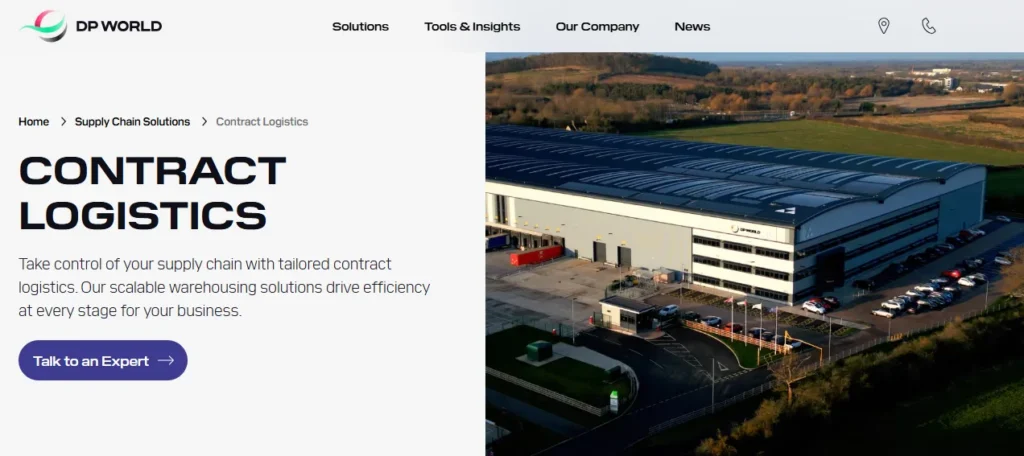
DP World
DP World’s website does one thing exceptionally well: it communicates scale without overwhelming the visitor. Within three seconds of landing on the homepage, you know exactly who they are and why they matter.
What works:
The hero section leads with impact, global trade routes, port operations, and supply chain reach, without a single word of corporate jargon. Their navigation separates audiences cleanly, so a Dubai-based shipper finds their solution instantly without digging through irrelevant pages.
Most importantly, they lead with numbers. “80+ countries.” “200+ business units.” In logistics, scale is trust, and DP World’s website understands this completely.
What to apply to your website: You don’t need DP World’s numbers to use this approach. “Serving UAE businesses since 2012”, “500+ shipments processed monthly”, “JAFZA-licensed operator”, specific, verifiable numbers on your homepage build more trust than any amount of professional photography.
Aramex
Aramex started in Amman, grew into a Dubai-headquartered global brand, and its website reflects exactly that balance. It feels regional and accessible while carrying genuine international authority.
What works:
The Arabic language toggle is prominent, not buried in a footer dropdown. This is a small decision that carries significant weight with Arabic-speaking clients across the UAE and wider GCC. Their shipment tracking tool sits front and centre because that’s what the majority of visitors actually come to do. They are designed for real user behaviour rather than what looks impressive in a design presentation.
On mobile, the experience is genuinely seamless. Tap, track, done. No pinching, no scrolling sideways, no frustration.
What to apply to your website: Identify the single most common action your visitors want to take, get a quote, check a shipment, find a warehouse location, and put it on your homepage, above the fold, impossible to miss. Remove every possible step between your visitor and that action.

Momentum Logistics
Momentum Logistics is based in Sharjah and serves the UAE and GCC markets. They’re not a global giant; they’re a regional operator. And their website leans into that identity rather than trying to sound like something they’re not.
What works:
Every service page is built around UAE-specific operations. JAFZA warehousing. UAE customs brokerage. Last-mile delivery across the seven emirates. A logistics manager in Dubai reads this and immediately thinks, these people understand my market, my regulations, my geography.
Their client logos are from recognisable UAE and GCC brands. A local business owner sees familiar names, and the trust barrier drops immediately.
What to apply to your website: Stop trying to sound global if your strength is local knowledge. “We’ve operated in JAFZA since 2010” is worth more to a Dubai client than “end-to-end global logistics solutions.” Your UAE-specific experience is a competitive advantage; your website should shout it, not bury it.

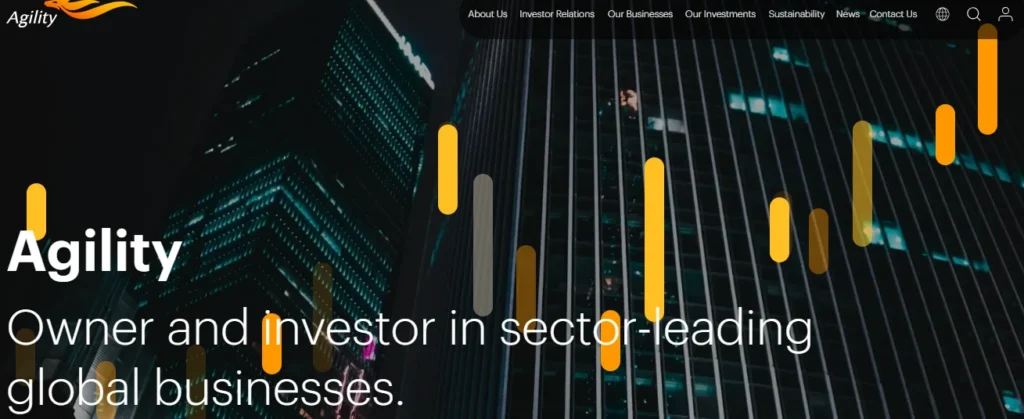
Agility Logistics
Agility has a significant UAE presence, and its website demonstrates the single most underused strategy in B2B logistics web design: dedicated industry pages.
What works:
Instead of one generic “our services” page, Agility has built separate landing pages for every industry they serve. Logistics for retail. Logistics for oil and gas. Logistics for healthcare. A procurement manager from an Abu Dhabi pharmaceutical company lands on a page that speaks directly to cold chain requirements, regulatory compliance, and pharma-specific challenges.
This approach does two things simultaneously: it converts visitors better because the content is immediately relevant, and it ranks for industry-specific searches that generic competitors completely miss.
What to apply to your website: If you serve more than one industry in the UAE, build a dedicated page for each. “Cold chain logistics Dubai” and “e-commerce fulfilment Dubai” are completely different searches with different buyers and different needs. One page cannot serve both audiences well.
3. Best Logistics Website Design Examples — Global Leaders
C.H. Robinson
C.H. Robinson is a Fortune 200 logistics provider, and their website solves a challenge that nearly every growing UAE logistics company eventually faces: how do you serve shippers, carriers, and freight agents on the same website without confusing everyone?
What works:
Their mega-menu navigation creates completely separate content journeys for different audience types. A carrier and a shipper land on the same homepage but immediately get directed to entirely different content experiences. Neither has to wade through information that isn’t relevant to them.
Their value proposition is refreshingly direct, no buzzwords, no vague promises, just a clear statement of what they do and for whom.
What to apply to your website: If your UAE logistics company serves more than one type of client, map out separate navigation paths for each. The extra planning is worth it; conversion rates improve significantly when visitors feel the content is speaking directly to them.

GlobalTranz
GlobalTranz went through a complete website overhaul after an acquisition made its existing site impossible to manage. Their story is relevant because it’s a situation we see regularly with UAE logistics companies that have grown quickly.
What works:
The redesign focused on three things: sitemap clarity, content flexibility for future growth, and distinct paths for different stakeholders. The result is a website that can scale with the business rather than becoming a liability every time something changes.
What to apply to your website: Ask yourself honestly, was your current website built for the company you were three years ago? If you’ve added services, entered new UAE markets, or expanded your team, your website has probably not kept pace. A sitemap review is often the highest-ROI first step in any UAE logistics website project.
Kesco Logistics
Kesco is the largest woman-owned 3PL in the United States, and its website leads with that distinction immediately. It’s a masterclass in positioning — knowing what makes you different and putting it front and centre rather than burying it in an about page.
What works:
In a sea of identical logistics websites all claiming “reliability, flexibility, and excellence,” Kesco immediately stands out. Their differentiator is stated on the homepage, in the navigation, and in every piece of content. Visitors remember them.
What to apply to your website: What makes your UAE logistics operation genuinely different? Not “great service”, every competitor claims that. Is it your specific free zone expertise? Your technology platform? Your industry specialisation? Find the one thing and lead with it everywhere.

4. What Every UAE Logistics Website Must Have in 2026
Based on building logistics websites specifically for the UAE market, these are the non-negotiable elements, the ones that directly affect whether visitors become enquiries.
Free Zone Credentials Prominently Displayed
JAFZA-licensed, DAFZA-registered, operating from Dubai Logistics City or DWC, state this clearly on your homepage. UAE businesses specifically seek free zone operators for customs and tax advantages. This single detail is often the deciding factor in a shortlisting decision.
WhatsApp Business Integration on Every Page
Not buried in the footer. Not a chatbot pretending to be WhatsApp. A genuine button on every page that opens a real conversation with your team. Place it in the header, in the hero section, and as a floating button. Test it on mobile first, that’s where 78% of your UAE visitors will see it.
Arabic Language Option
You don’t need every page translated. Start with your homepage, your key service pages, and your contact page. The SEO benefit alone, appearing in Arabic-language searches, makes this worthwhile. The trust signal it sends to Arabic-speaking decision-makers across the UAE and GCC is significant.
UAE Regulatory Trust Signals
Dubai Chamber of Commerce membership. ISO 9001 certification. UAE customs authority accreditation. RTA compliance where relevant. These aren’t decorative badges; they are objection-killers for every serious B2B buyer evaluating your company. They belong in your header or hero section, not the footer.
Specific Location Information
“UAE Operations” means nothing. “Warehouse 7, JAFZA South, Dubai, 04 XXX XXXX” builds immediate credibility. If you have multiple locations across the Emirates, list each one specifically. Buyers want to know you’re physically present where they need you.
Real Photography, Not Stock Images
A smiling pilot shaking hands with a businessman tells a UAE client nothing about your actual capabilities. Photos of your real warehouse, your actual team, your genuine vehicles, these build trust that no stock image library can replicate.
5. The Biggest Mistakes UAE Logistics Websites Make
These are the patterns that quietly cost UAE logistics companies real business every month.
Mistake 1: Designed for the owner, not the buyer
Most logistics websites describe the company’s capabilities from the inside out. Your buyer doesn’t care about your internal processes; they care about their problem. Rewrite every page starting with the customer’s challenge, then show how you solve it.
Mistake 2: Contact forms with too many fields
Nobody in Dubai is filling out a ten-field form before speaking to you. Name, email, and one line about their need. That’s all you need to start a conversation. Every additional field reduces your conversion rate.
Mistake 3: No case studies or real results
“We provide excellent service with a commitment to reliability” means nothing. “We reduced a Dubai retailer’s inbound logistics cost by 22% within six months of switching to our 3PL service” means everything. Even one strong, specific case study changes how potential clients perceive your entire operation.
Mistake 4: Slow loading on mobile
UAE internet infrastructure is excellent. If your website takes more than three seconds to load, the problem is your website — not the connection. Every additional second of load time costs approximately 7% of conversions. On mobile, this compounds fast.
Mistake 5: No pricing signal whatsoever
You don’t need to publish rate cards. But phrases like “transparent quotes within 24 hours” or “competitive warehousing rates for UAE businesses” set expectations and reduce the friction that stops people from making contact. Complete price silence makes buyers assume you’re expensive.
Mistake 6: Treating the website as a brochure
Your website should be your best-performing sales tool, not a static document that gets updated once every three years. Regular blog content, client case studies, industry updates, and service page refinements keep your website working as an active part of your business development.
6. How to Choose the Right Agency to Build Your Logistics Website in Dubai
If you’ve decided it’s time to invest in a proper logistics website for your UAE operation, choosing the right agency is as important as the design itself. Here’s what to look for.
They understand logistics, not just design
A general web design agency will build you a beautiful website that uses all the wrong language and targets all the wrong buyers. Look for an agency with specific experience in logistics, freight, 3PL, or supply chain, ideally with UAE or GCC clients they can show you.
They lead with strategy, not templates
The first conversation with a good agency should be about your business goals, your target clients, and your competitive position in the UAE market. If they jump straight to showing you templates and packages, move on.
They talk about SEO from the beginning
A logistics website that nobody finds is just an expensive business card. Your agency should be discussing keyword strategy, on-page optimisation, and local UAE SEO before a single design decision is made. If SEO is an afterthought or an optional add-on, that’s a red flag.
They have real UAE market knowledge
The UAE B2B market is different from Europe and the US. Buyer behaviour is different. Trust signals are different. The role of WhatsApp, the importance of free zone credentials, and the Arabic language consideration, an agency that understands these nuances will build you something significantly more effective than one that doesn’t.
They show you results, not just aesthetics
Ask any agency you’re considering: “What happened to lead volume after you launched this client’s website?” If they can only show you how it looks but not what it delivers, that tells you everything about how they think about your investment.
FAQs
How much does a logistics website design cost in Dubai?
For a professional, SEO-optimised logistics website in Dubai, expect to invest anywhere between AED 15,000 and AED 80,000, depending on scope, number of pages, custom functionality, and whether Arabic language versions are included. Template-based builds at the lower end; fully custom, conversion-focused builds at the higher end. The ROI on a properly built logistics website in the UAE typically makes this one of the highest-return marketing investments available.
How long does it take to build a 3PL website in the UAE?
A well-built logistics website typically takes 8 to 14 weeks from strategy to launch. Rushing this timeline usually results in a website that needs significant rework within 12 months. Factor in time for content creation, UAE-specific copywriting, and proper SEO setup; these are not steps to skip.
Do I need an Arabic version of my logistics website?
For UAE-focused logistics companies, yes, at a minimum for your homepage and key service pages. Arabic-language searches represent a significant portion of UAE B2B research, and having Arabic content gives you visibility that English-only competitors simply don’t have. It also sends a strong trust signal to Arabic-speaking decision-makers across the UAE and GCC.
What makes a logistics website rank on Google in the UAE?
UAE-specific keyword targeting is the starting point; “freight forwarding Dubai” ranks differently from “freight forwarding” globally. Beyond that: page speed optimised for mobile, locally relevant content mentioning specific UAE locations and free zones, genuine backlinks from UAE business directories and industry sources, and consistent publishing of practical content that answers questions your buyers are actually searching for.
Absolutely, and it should be visible on every page, not just the contact page. In the UAE, WhatsApp is the primary business communication channel for many buyers. A prominent WhatsApp button typically increases inbound enquiries by 40-60% compared to contact forms alone, based on what we see across logistics clients in the UAE market.
How often should I update my logistics website?
The static pages, services, about, and contact should be reviewed every six months and updated whenever your capabilities or credentials change. For SEO and authority building, publishing one substantive piece of content per month (case study, industry insight, practical guide) is the minimum that produces meaningful organic traffic growth in competitive UAE markets.
What’s the difference between a good and a bad logistics website?
A bad logistics website describes the company. A good one solves the buyer’s problem. A bad one lists services. A good one shows results. A bad one makes you search for a phone number. A good one puts a WhatsApp button in front of you within three seconds of arriving. The difference, in practice, is the difference between a website that costs you money and one that makes you money.
Based in the UAE and ready to build a logistics website that actually generates leads? We work specifically with 3PL, freight, and supply chain companies across Dubai, Abu Dhabi, and Sharjah. Get a free website review →
About the author


Popular Posts

The Importance of Cybersecurity in the Security of Customer Data
March 13, 2026- 5 Min Read
20 Best Ecommerce Website Design Examples for Inspiration (2026)
March 6, 2026- 9 Min Read

Astrology Website Design and Development: Examples & Best Practices
March 3, 2026- 6 Min Read