

- About us
-
Services
- Back
- Development Services
-

-
-
-
- Designing Services
-
-
-
-
- Marketing Services
-
-
-
-
- Cloud Engineering Services
-
-
-
- ERP
-
-
-
- CRM
-
-
-
- Artificial Intelligence
-

-
-
-
- MVP
-
- Industry
- Portfolio
- Career
- Contact us
-
 info[at]startdesigns.com











Here’s a stat that should stop you in your tracks, 90% of startups fail. But the ones that survive? Almost all of them have one thing in common: they launched small, learned fast, and built exactly what their users actually wanted.
Amazon didn’t start as the ‘everything store.’ Airbnb was just three air mattresses in a San Francisco apartment. Uber began with a single iPhone app and fewer than ten drivers. These weren’t billion-dollar launches. They were scrappy, imperfect, intentionally small, and that’s exactly why they worked.
In this article, we’ve gone deeper than any other MVP roundup you’ll find online. We studied 35 real MVP examples and how each was built, what problem it solved, what the founders validated, and most importantly, what lessons you can take from each story and apply to your own idea today in 2026.
Whether you’re a first-time founder, a product manager testing a new feature, or an entrepreneur trying to convince investors your idea has legs, this guide is your playbook.
What is a Minimum Viable Product (MVP)?
A Minimum Viable Product (MVP) is the simplest version of your product that still delivers real value to real users and, more importantly, generates real feedback. It’s not a half-baked product. It’s not a prototype. It’s a deliberately focused version of your solution designed to test your riskiest assumption as cheaply and quickly as possible.
Eric Ries, who popularized the concept in The Lean Startup, described it as the version of a new product that allows a team to collect the maximum amount of validated learning about customers with the least effort.
The keyword there is validated. An MVP isn’t about building fast — it’s about learning fast.
MVP vs Prototype — The Critical Difference
| Factor | MVP | Prototype |
| Purpose | Validate market demand with real users | Test design/concept internally |
| Users | Real customers, early adopters | Internal team, stakeholders |
| Functionality | Core features only — fully working | Visualize how the product might work |
| Feedback | Real market feedback | Internal design feedback |
| Goal | Learn what customers actually want | Visualize how product might work |
| Revenue | Can generate early revenue | Not meant for revenue |
What Makes an MVP ‘Viable’?
This is where most founders go wrong. They either build too little (a rough prototype with no real value) or too much (a feature-rich product that takes 18 months to launch). Viable means:
- It solves a real, specific problem for a real, specific person
- Someone can complete a transaction or core action from start to finish
- It delivers enough value that users would be disappointed if it disappeared
- It generates learnable data, sign-ups, usage patterns, feedback, and churn
Why Build an MVP? The Business Case
Before we dive into the examples, let’s be clear on why this approach works, especially in 2026, where AI tools have made full product development faster than ever, yet the failure rate for new products remains stubbornly high.
| Benefit | What It Means For You |
| Faster Time to Market | Launch in weeks, not months. Beat competitors to early adopters. |
| Lower Financial Risk | Spend $10K validating before committing $200K to full development. |
| Real User Data | Replace assumptions with actual behavior data before major investment. |
| Investor Attraction | A working MVP with 500 users is 10x more fundable than a pitch deck. |
| Pivot Clarity | Know early if you need to change direction before sunk costs pile up. |
| Team Alignment | Forces the team to agree on what’s truly essential vs. nice-to-have. |
6 Types of MVPs (With Real Examples for Each)
Not all MVPs look the same. The type you choose depends on your product, your users, and what specific assumption you’re trying to validate. Here’s a breakdown of the six main MVP types, each with a real example:
| MVP Type | Best For | Real Example | Cost Level | Risk Level |
| Concierge MVP | Service businesses, marketplaces | Food on the Table | Very Low | Very Low |
| Wizard of Oz MVP | Automation/AI products | AdWords Express, Zapier | Low | Low |
| Landing Page MVP | Validating demand before building | Buffer, Dropbox (teaser) | Very Low | Very Low |
| Single Feature MVP | SaaS, apps with broad scope | Foursquare, Instagram | Medium | Medium |
| Piecemeal MVP | Marketplaces, aggregators | Groupon, DoorDash | Low | Low |
| Email MVP | Newsletters, subscription products | Product Hunt | Very Low | Very Low |
Concierge MVP
In a concierge MVP, you perform the work manually rather than building software to automate it. You’re not pretending to have automation; you openly serve users by hand to understand if they want the service at all. This is the fastest way to validate a service-based idea with zero tech investment.
Wizard of Oz MVP
In this type, users believe the product is fully automated. Behind the scenes, humans are performing the manual work. It creates the illusion of a functioning product while you gather real demand data. Named after the movie’s famous curtain-hiding wizard, what looks like magic is just a person pulling levers.
Landing Page MVP
Before you build anything, create a simple web page that describes your product and includes a call-to-action (join waitlist, pre-order, sign up). The conversion rate tells you whether genuine demand exists. Buffer famously validated their entire concept this way before writing a single line of product code.
Single Feature MVP
Strip everything away and launch with just one core feature. This forces product clarity and lets you measure whether that core value proposition resonates before adding complexity. Instagram launched with just photo sharing and filters. That was enough.
Piecemeal MVP
Build your MVP using existing tools and platforms instead of custom development. Groupon ran on WordPress. DoorDash used a simple website and personal phone calls. Zapier manually connected APIs before building automation. When the model is proven, then you build the real infrastructure.
Email MVP
Send a manually curated email to potential users. Track opens, clicks, and replies to validate interest and gather feedback before investing in a full product. Product Hunt started as a daily email newsletter before becoming a platform.
35 Successful MVP Examples That Changed Their Industries
Here are 35 real MVP stories, not just company names with one-line descriptions, but the actual founding story, what the MVP looked like, what was validated, and what you can learn from each.
Classic Tech Giants
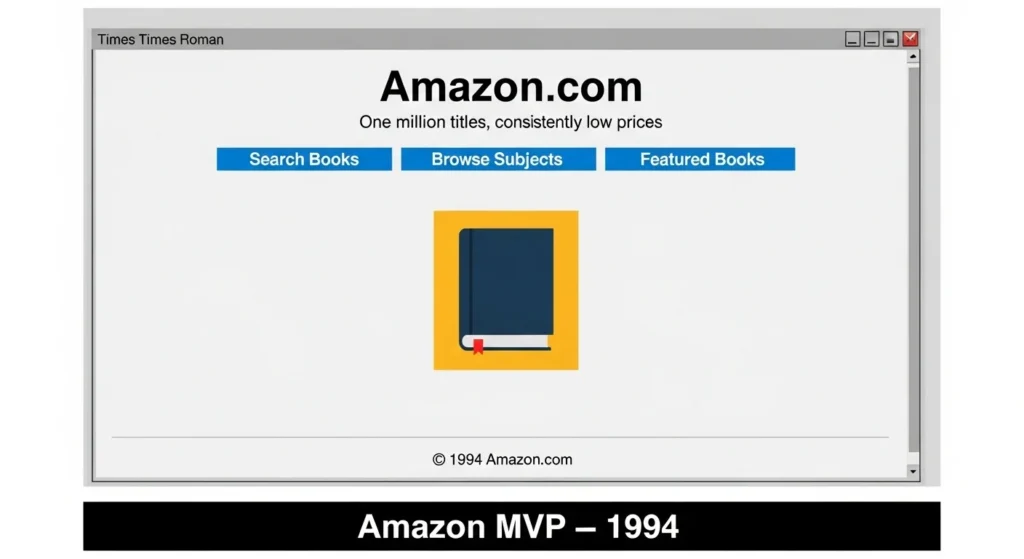
1. Amazon
The Problem
In 1994, Jeff Bezos read a report predicting 2,300% annual growth in web commerce. He wanted to build a massive online store but knew that ‘selling everything’ was impossible to validate.
The MVP
Bezos started with just one product category: books. He built a bare-bones website, bought books from distributors only after orders came in (no warehouse inventory needed), and shipped them himself from his garage in Bellevue, Washington. There was no recommendation engine, no Prime, no reviews, just a basic product listing and a checkout.
What Was Validated
People will buy physical products online without touching them first. Books had global demand, standardized formats, and low return rates, perfect for online retail validation.
The Lesson
Start with the most focused version of your vision. Bezos had a massive dream, but launched with the minimum. Once the model worked for books, expansion became data-driven, not speculative.
| Revenue Impact: Amazon’s 1995 book sales validated e-commerce. By 1997, they went public. Today, Amazon generates over $574 billion in annual revenue across dozens of categories. |
2. Airbnb — Three Air Mattresses and a Web Page
The Problem
In 2007, Brian Chesky and Joe Gebbia were broke in San Francisco and couldn’t afford rent. A design conference was coming to town, and every hotel was booked.
The MVP
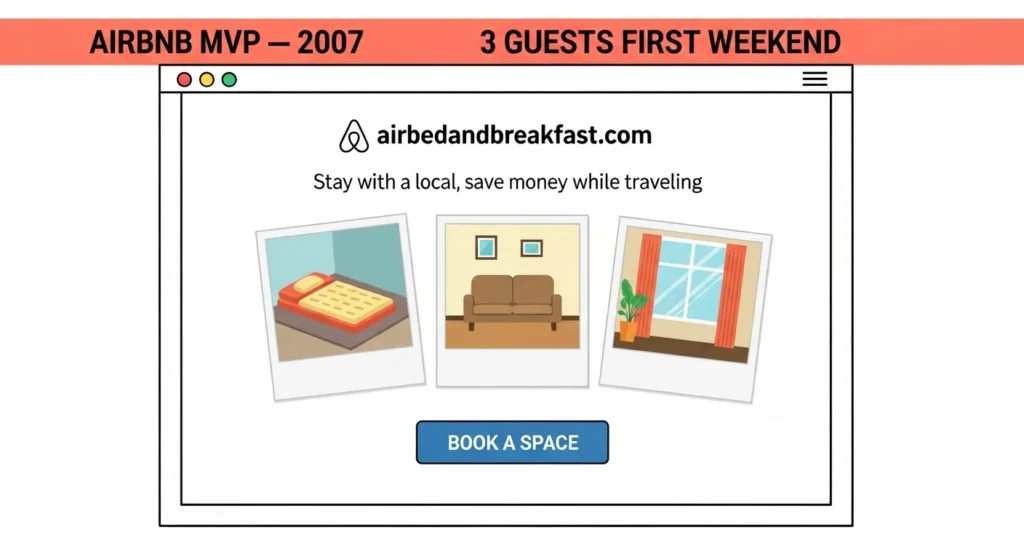
They blew up three air mattresses, took photos of their loft, threw up a rudimentary website called ‘Air Bed and Breakfast,’ and offered breakfast with the stay. No booking system, no reviews, no payment processing, just a basic page with photos. They got three guests that first weekend.
What Was Validated
Strangers will pay to stay in other strangers’ homes. The safety concern (will people trust this?) was the riskiest assumption, and it was proven with real guests immediately.
The Lesson
The scrappiest MVP can validate the biggest assumption. Chesky later said that going to meet those first guests personally, learning their names, understanding their experience, gave Airbnb insights no survey ever could.
| Revenue Impact: From three air mattresses to a $75 billion valuation. Airbnb now has 7+ million listings in 220+ countries and generates $9.9 billion in annual revenue. |
3. Uber — One City, Three Drivers, One App
The Problem
In Paris, 2008, Travis Kalanick and Garrett Camp couldn’t get a cab during a snowstorm. Camp had also been inspired by a James Bond scene where a car was tracked via mobile phone. Their shared frustration became a shared vision.
The MVP
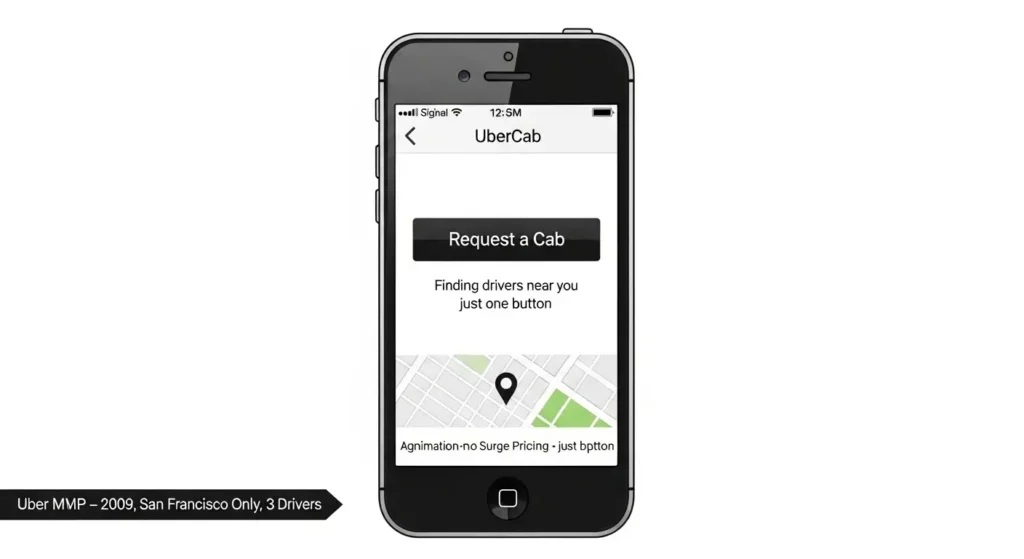
In 2009, they built a basic iPhone app (no Android, no surge pricing, no UberPool). They launched only in San Francisco with a handful of drivers — actual black car operators. Users could tap once to request a car, watch it arrive on a map, and pay automatically via the app. No cash. No calling a dispatcher.
What Was Validated
People will pay a premium for reliable, trackable, cashless rides. The core assumption — that GPS-enabled, on-demand transportation could work as a business — was proven within weeks of launch.
The Lesson
Geographic restraint is a superpower in MVP testing. Uber’s ‘one city’ focus let them obsess over operations, pricing, and driver experience before scaling. Every marketplace startup should do this.
| Revenue Impact: Uber now operates in 70+ countries with 189 million users. 2023 revenue was $37.3 billion. The MVP cost a few thousand dollars to build. |
4. Dropbox — A 3-Minute Video as an MVP
The Problem
In 2007, Drew Houston kept forgetting his USB drive. He wanted to build seamless cloud file syncing, but building the actual infrastructure would cost millions and take years.
The MVP
Instead of building the product, Houston made a 3-minute screencast video demonstrating what Dropbox would do. The video was casual, slightly funny, and showed a future product that didn’t fully exist yet. He posted it on Hacker News overnight.
What Was Validated
The demand was enormous. Overnight, Dropbox’s beta waitlist grew from 5,000 to 75,000 people. They didn’t need a product to prove the market existed; they needed a video.
The Lesson
Your MVP doesn’t have to be a product. For technical or infrastructure-heavy ideas, validating demand before building is not just smart, it’s essential. A video, a landing page, or a demo can be your MVP.
| Revenue Impact: Dropbox IPO’d in 2018 at a $9.2 billion valuation. Today, it serves 700 million registered users in 180+ countries. |

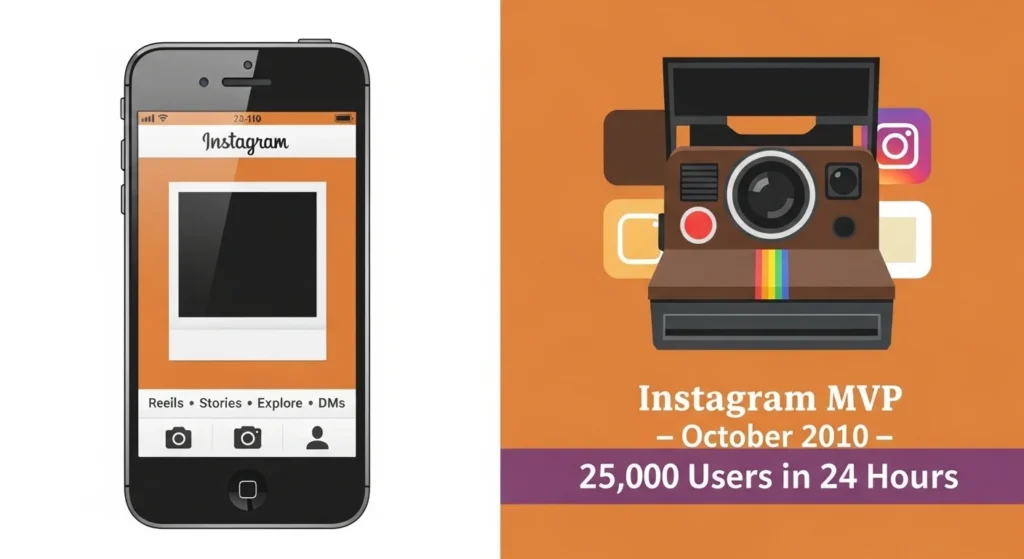
5. Instagram — A Pivot From a Failing App
The Problem
Kevin Systrom and Mike Krieger originally built Burbn, a location check-in app packed with features. It was cluttered, confusing, and users weren’t engaging. The app was going nowhere.
The MVP
They analyzed their data and found one pattern: users loved the photo-sharing feature inside Burbn. Everything else was ignored. So they deleted the entire app and rebuilt it with just two features: share a photo and apply a filter. That stripped-down product became Instagram.
The Lesson
Sometimes the MVP insight comes after launch. Monitor your data obsessively. The feature your users love might not be the one you built the app around. Be willing to throw away everything and rebuild around the signal.
| Revenue Impact: Instagram launched in October 2010. Within 24 hours, 25,000 users signed up. Facebook acquired it in 2012 for $1 billion. Today, Instagram generates an estimated $70 billion annually in ad revenue. |
6. Facebook — Harvard Students Only
The Problem
In 2003, college students had no good way to connect digitally with their campus social circle. Mark Zuckerberg, then a Harvard sophomore, saw the gap.
The MVP
‘TheFacebook’ launched exclusively for Harvard students in February 2004. Users could create a profile, post to a wall, and connect with classmates. No news feed, no advertising, no groups, no events. Just basic profiles and connections, restricted to one university’s email domain.
What Was Validated
College students would eagerly use a campus-specific social network. Within 24 hours, 1,200 Harvard students signed up. Within a month, half of all Harvard undergrads had profiles.
The Lesson
Radical restriction creates obsessive early adopters. ‘Harvard only’ wasn’t a limitation; it was a growth strategy. Exclusivity drove desire. When you open access gradually, you control quality and generate buzz simultaneously.
| Revenue Impact: Facebook (now Meta) has 3.27 billion daily active users across its platforms. 2023 revenue: $134.9 billion. |

7. Zappos — Fake Inventory, Real Sales
The Problem
Nick Swinmurn had a hunch in 1999 that people would buy shoes online, but he had zero evidence and zero inventory. The conventional wisdom said customers needed to try shoes on before buying.
The MVP
Swinmurn went to local shoe stores, photographed their inventory, and posted the photos on a basic website. When someone placed an order, he went back to the store, bought the shoes at retail price, and shipped them himself. He was losing money on every sale, but that wasn’t the point.
What Was Validated
People will buy shoes online without trying them on. The risk wasn’t the business model; it was the consumer behavior assumption. That assumption was validated without needing a warehouse, supplier relationships, or a logistics system.
The Lesson
Lose money intentionally to learn something priceless. Swinmurn’s early negative margins bought him market validation data that was worth far more than the few dollars lost per order.
| Revenue Impact: Amazon acquired Zappos in 2009 for $1.2 billion. Zappos now generates over $2 billion in annual sales. |
| Pattern We NoticedPattern #1 (Companies 1-7): Every tech giant we’ve studied launched in a single category, or single city or university. Restriction is a strategy, not a constraint. The most successful early-stage products were narrower than their founders originally planned. |

Marketplace & On-Demand MVPs
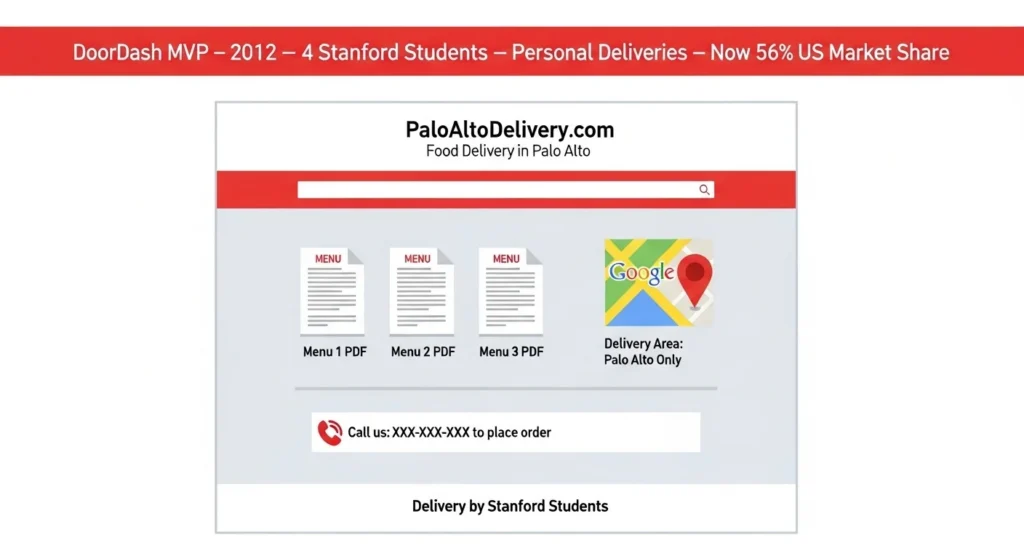
8. DoorDash — A PDF Menu and a Phone Number
The Problem
In 2012, four Stanford students, Tony Xu, Andy Fang, Stanley Tang, and Evan Moore, were doing user research interviews with local restaurant owners in Palo Alto. A macaroon shop owner told them her biggest pain point was local delivery.
The MVP
In one afternoon, they built PaloAltoDelivery.com, a simple website with PDF menus from eight local restaurants and a phone number. They personally took the orders and delivered the food themselves using their own cars. There was no app, no algorithm, no driver network.
What Was Validated
Restaurants needed third-party delivery help desperately, and customers wanted delivery from restaurants that didn’t offer it. Both sides of the marketplace had real unmet demand.
The Lesson
Do the manual work yourself before automating it. By personally delivering orders, the DoorDash founders understood the logistics challenges, driver experience, restaurant workflows, and customer expectations intimately before writing a line of code.
| Revenue Impact: DoorDash launched properly in June 2013. Today, it holds 56% of the US food delivery market share. 2023 revenue: $8.6 billion. |
9. Airbnb for Cars — Turo (RelayRides)
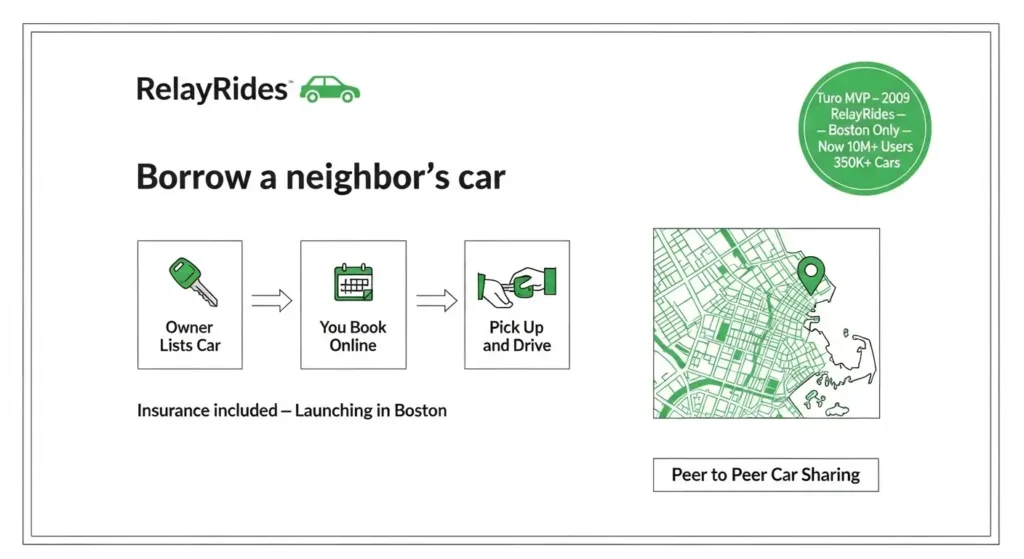
The Problem
Shelby Clark was biking through icy streets to rent a car two miles away in 2009. He passed dozens of parked, unused cars along the way and thought: Why can’t I just rent one of those?
The MVP
Clark and his co-founders launched RelayRides, a peer-to-peer car rental platform where private car owners could rent their vehicles to others. The initial MVP was hyperlocal, focused on Boston, with manual insurance arrangements, manual listings, and basic online booking.
What Was Validated
Car owners would rent their vehicles to strangers for income. The insurance problem was the riskiest assumption — once they solved it, demand was consistent.
The Lesson
The biggest barrier to your MVP launch is usually one specific problem. Identify it and solve that one problem first. For RelayRides, it was insurance. Everything else could wait.
| Revenue Impact: Rebranded as Turo in 2015. Now has 10 million+ users, 350,000+ vehicles, and an estimated 2024 annual revenue of $900 million. |
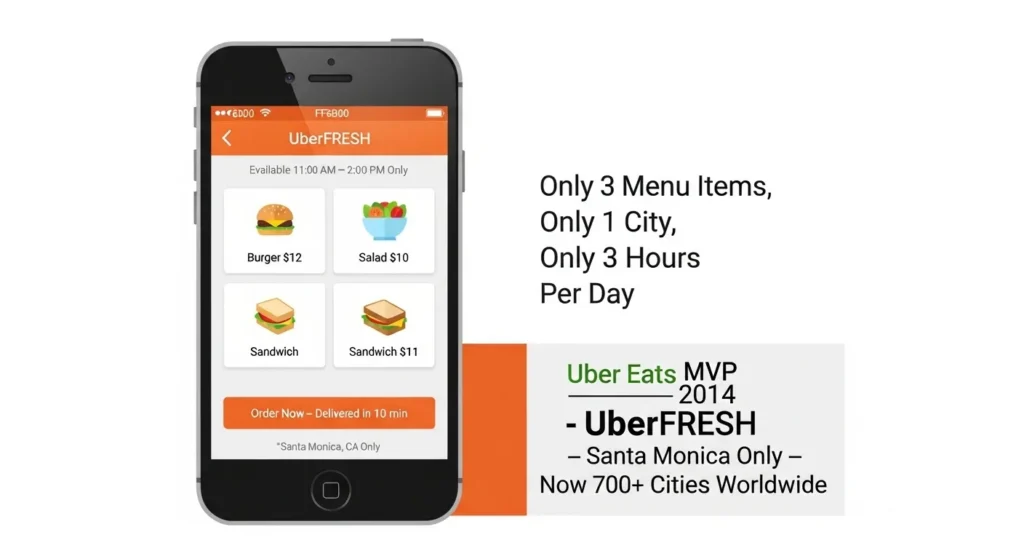
10. Uber Eats — UberFRESH: 11 am to 2 pm Only
The Problem
The MVP
In August 2014, Uber launched UberFRESH in Santa Monica, California. It was available only from 11 am to 2 pm. Customers chose from a curated set of three lunch options from a handful of local restaurants. No customization, no dinner, no breakfast, just three choices at lunchtime. Orders were delivered by Uber drivers between rides.
Uber had a driver network and a logistics platform already running. Could they leverage it for something beyond rides? Founders wanted to explore adjacent revenue streams.
What Was Validated
Uber’s driver and logistics infrastructure could support food delivery. Demand was real enough to justify building a dedicated product around it.
The Lesson
Radical time and menu restriction let Uber test the logistics model without overwhelming complexity. When you don’t know if something will work, artificially constrain it so failure is affordable.
| Revenue Impact: UberFRESH became Uber Eats in 2015. Today, Uber Eats operates in 700+ cities worldwide. Delivery revenue was $12.1 billion in 2023. |
11. Etsy — A Marketplace for People Who Made Things
The Problem
Rob Kalin was a woodworker who wanted to sell his handcrafted wooden-cased computers online. He found eBay and Amazon too generic, too focused on mass-produced goods. There was nowhere for artisans and craftspeople to sell.
The MVP
Kalin, Chris Maguire, and Haim Schoppik built a simple marketplace in 2005 focused specifically on handmade and vintage goods. The MVP was a basic two-sided marketplace: sellers listed items, buyers browsed, and purchased. No algorithm-driven discovery, no promoted listings, no reviews, just a clean, category-organized storefront for crafters.
What Was Validated
There was an enormous, underserved community of artisans who wanted a niche marketplace, and buyers who wanted unique, handmade alternatives to mass-produced products.
| Revenue Impact: Etsy now has 7.5 million active sellers and 92 million active buyers. 2023 revenue: $2.7 billion. |
12. Fiverr — Everything for $5, Full Stop
The Problem
Freelancing platforms like Elance and oDesk (now Upwork) required negotiation, proposals, and lengthy hiring processes. For small, defined tasks, this friction was too high.
The MVP
Micha Kaufman and Shai Wininger launched Fiverr in 2010 with one rigid rule: every service costs exactly $5. No negotiation, no bidding, no packages. Sellers listed what they’d do for $5. Buyers bought it. The extreme constraint made the product instantly understandable.
What Was Validated
A huge market existed for micro-task freelancing at a fixed, low price point, especially for digital services. The $5 constraint created a category in itself: ‘fiverr gigs’ became a new concept in the gig economy vocabulary.
The Lesson
Artificial constraints can be your biggest differentiator. Fiverr’s $5 rule wasn’t a limitation; it was their entire brand identity. Once the model proved itself, they introduced tiered packages. But that constraint got them to market and into users’ consciousness.
| Revenue Impact: Fiverr IPO’d in 2019. 2023 revenue: $361 million with 4+ million active buyers on the platform. |
13. Groupon — A WordPress Blog and PDF Coupons
The Problem
Andrew Mason had an idea in 2008: what if local businesses could offer deals that only activated when enough people signed up, and group buying power applied to everyday spending?
The MVP
Groupon launched on a basic WordPress website. When a deal was live, interested customers entered their email. When the minimum number of buyers was reached, the deal was activated, and Groupon’s team manually emailed PDF coupons to all participants. No payment processing integration. No automated notifications. Just a WordPress blog, email, and PDFs.
What Was Validated
Businesses would offer deep discounts in exchange for volume, and consumers would commit to purchases for a good enough deal. The collective buying model worked even at tiny scale.
The Lesson
Automation is not required to prove a business model. Groupon proved group buying worked with WordPress and email before building any custom technology. Once they had the data, they built properly. This is the piecemeal MVP at its best.
| Revenue Impact. At its peak in 2011, Groupon was valued at $13 billion — the fastest company to reach $1 billion in revenue in business history at that time. |
14. Rent the Runway — Pop-Up Dress Try-Ons
The Problem
Jennifer Hyman watched her sister go into credit card debt over a $2,000 dress she’d wear once. The insight: fashion is about occasion, not ownership. Could women rent designer clothes instead of buying?
The MVP
Before building a website, Hyman and Jenny Fleiss ran pop-up events at Harvard dorms where they let female students try on designer dresses. First, they watched women try on and immediately wanted to rent. Then they tested renting without trying, just browsing photos. Then they moved the whole experience online. Each step validated the next.
What Was Validated
Women would rent high-end fashion for special occasions rather than buy. The pop-up events also revealed critical operational insight: women needed to know the dress fit before committing, which shaped Rent the Runway’s unique ‘borrow before you commit’ feature.
| Revenue Impact: Rent the Runway IPO’d in 2021 and now generates over $300 million in annual revenue with 2.4 million lifetime members. |
| Pattern We Noticed Pattern #2 (Companies 8-14): Every marketplace MVP in this group manually handled both sides of the marketplace before automating. DoorDash delivered food personally. Zappos bought shoes at retail. Groupon emailed PDFs. The pattern: prove unit economics manually, then build the platform. |
Social & Communication MVPs
15. LinkedIn — A Free Profile and a Premium Paywall
The Problem
In 2002, Reid Hoffman, then an executive at PayPal, believed professionals needed a dedicated social platform. General social networks weren’t designed for business context, career history, or professional networking.
The MVP
Launched on May 5, 2003, LinkedIn’s MVP was straightforward: create a professional profile for free, invite connections, and access expanded features (like seeing who viewed your profile) via a paid subscription. No feed, no LinkedIn Learning, no job postings initially. Just professional profiles and the ability to connect.
What Was Validated
Professionals would use a dedicated social network for career development, and a freemium model (free base, paid premium) would drive subscription revenue. Within the first month, 4,500 users joined. Within a year: 1 million.
| Revenue Impact: Microsoft acquired LinkedIn in 2016 for $26.2 billion. Today, LinkedIn has 1.1 billion members worldwide and generates $15+ billion annually. |
16. Twitter — Internal SMS Tool at a Podcast Company
The Problem
In 2006, Odeo, a podcast platform, was facing an existential crisis after Apple announced iTunes would include podcast support. The team held a hackathon to brainstorm new directions.
The MVP
Jack Dorsey pitched a simple idea: an SMS-based service where you share short status updates with a small group. The prototype was built in two weeks and used entirely within the Odeo office. Employees used it to share what they were doing throughout the day. The character limit was born from SMS constraints: 140 characters.
What Was Validated
People want a lightweight, public-facing broadcast layer for thoughts, activities, and real-time updates, completely separate from private messaging or long-form content.
The Lesson
Build for yourself first. Twitter’s earliest users were the team building it. Their genuine use of it, finding it valuable, addictive even, was the first validation signal. If your own team doesn’t want to use your MVP, that’s a warning.
| Revenue Impact: Twitter (now X) was valued at $44 billion when Elon Musk acquired it in 2022. At its peak it had 350+ million monthly active users. |
17. Foursquare — One Feature: Check-In and Earn Badges
The Problem
In 2009, Dennis Crowley wanted to solve a deceptively simple problem: help people discover great local places and share their location adventures with friends.
The MVP
Foursquare launched with a single feature: location check-ins. Users could ‘check in’ at a location, see if friends were nearby, and earn badges for visiting certain types of places or achieving check-in streaks. No restaurant reviews, no business listings, no city guide. Just gamified check-ins.
What Was Validated
Gamification (badges, mayorships, leaderboards) could drive consistent location-sharing behavior. The MVP validated both the social layer and the location data layer simultaneously, and that location data became the real asset.
| Revenue Impact: Foursquare pivoted its location data into a B2B business and is now valued at over $1.3 billion, powering location intelligence for thousands of apps, including Apple Maps and Snapchat. |
18. Slack — Built for a Gaming Company’s Internal Team
The Problem
Stewart Butterfield was building a game called Glitch. His distributed team needed a better way to communicate than email chains and IRC. He built an internal messaging tool to solve his own team’s problem.
The MVP
When Glitch failed in 2012, Butterfield pivoted to the internal communication tool itself. They invited a small number of friendly companies to use it and give feedback. Slack’s MVP was simply a workplace messaging platform, channels, direct messages, and file sharing. No bots, no integrations, no workflows.
What Was Validated
Teams would abandon email for an organized, channel-based messaging platform, and they would pay for it. Beta companies like Rdio and Medium gave feedback that shaped the product’s most important early features.
| Revenue Impact: Salesforce acquired Slack in 2021 for $27.7 billion. Slack now has 20+ million daily active users. |
19. Clubhouse — iPhone Only, Invite Only
The Problem
In early 2020, Paul Davison and Rohan Seth believed audio-first, live conversation was an underexplored format. Video calls felt formal. Text threads felt flat. There was a gap for spontaneous, real-time voice rooms.
The MVP
Clubhouse launched in April 2020 as an iPhone-only, invite-only app. No Android version. No recording. No reply. If you missed a room, it was gone. You needed to know someone to get in. These constraints were intentional; they created scarcity, community feeling, and FOMO.
What Was Validated
Live, ephemeral audio rooms could create genuine community and virality. The invite-only model created genuine social pressure to get access, which drove word-of-mouth growth without any paid marketing.
| Revenue Impact. At its peak in early 2021, Clubhouse was valued at $4 billion and had 10 million weekly active users. |
| Pattern We Noticed: Pattern #3 (Companies 15-19): Social MVPs grew through artificial scarcity, Harvard only, office only, invite only, one platform only. Restriction created desire. When everyone can join from day one, nobody feels urgency. Strategic exclusivity is a proven growth mechanism. |
SaaS & Developer Tool MVPs
20. Dropbox — Video MVP (Expanded Deep Dive)
We covered Dropbox above, but there’s a specific product lesson worth expanding: Drew Houston built the technology incrementally after demand was proven. He reverse-engineered Apple’s filesystem integration to add the Dropbox icon to Mac’s dock, a small UX touch that made the product feel native and indispensable. Every incremental tech improvement came after the demand was proven, not before.
21. Stripe — Seven Lines of Code
The Problem
Patrick and John Collison noticed that accepting payments online in 2010 required weeks of integration work, bank agreements, and painful legacy APIs. Developers hated it.
The MVP
The Collison brothers built a payment API so simple that developers could integrate it with seven lines of code. Their early ‘sales’ strategy was famously called the ‘Collison Installation’ — when someone expressed interest, they’d say ‘Let me install it for you right now’ and walk them through integration on the spot, learning from every friction point in real time.
What Was Validated
Developers would pay for a dramatically simpler payment infrastructure and would spread the word to other developers. Developer-led growth through word-of-mouth became Stripe’s go-to-market strategy.
| Revenue Impact: Stripe is now valued at $65+ billion and processes hundreds of billions in payments annually, serving millions of businesses worldwide. |
22. Notion — Internal Productivity Tool First
The Problem
Ivan Zhao started Notion as a tool for his own team to manage projects, notes, and documents, frustrated that every existing tool was either too rigid or required switching between multiple apps.
The MVP
The early version of Notion was a bare-bones tool with basic block editing and page nesting. Zhao and his small team dogfooded it obsessively, finding the right balance between flexibility and simplicity before opening it to the public. When it launched publicly, it had a cult-like early adopter base who’d been eagerly waiting.
The Lesson
Building for yourself first gives you the most honest feedback loop. You can’t bullshit yourself into thinking a feature works if you use it daily and find it frustrating.
| Revenue ImpactNotion was valued at $10 billion in 2021 and has over 30 million users worldwide. |
23. Buffer — Landing Page Before Product
The Problem
Joel Gascoigne wanted to build a social media scheduling tool, but had no idea if anyone would pay for it. Building it would take months.
The MVP
He built a two-page website in a weekend. Page 1: ‘Buffer helps you share smarter on Twitter, find out more.’ Page 2 (after clicking): ‘Buffer is in development. Enter your email to be notified.’ He drove traffic to it. Hundreds of people signed up. Then he built a pricing page. When people clicked through to pricing, he knew they had purchase intent.
What Was Validated
Demand for scheduled social media posting was real, and people had payment intent before a single feature was built. Buffer’s MVP validated the entire business without a product.
| Revenue Impact: Buffer is now a profitable company generating $22+ million in annual recurring revenue with over 140,000 paying customers. |
24. Figma — Browser-Based Design Only
The Problem
In 2012, Dylan Field and Evan Wallace wanted to build a design tool that was collaborative by default, but every design tool (Sketch, Photoshop) was a downloaded desktop app with no real-time collaboration.
The MVP
Figma’s MVP ran entirely in the browser using WebGL, a controversial technical choice that most experts said was impossible for professional design tools. The initial version had limited features compared to Sketch, but proved the core thesis: real-time collaborative design was possible in a browser.
What Was Validated
Designers would compromise on some features in exchange for real-time collaboration and browser accessibility, especially in team environments where sharing and feedback were constant pain points.
| Revenue Impact: Adobe attempted to acquire Figma for $20 billion in 2022 (blocked by regulators). Figma now has 4 million+ users and $700M+ in ARR. |
25. Zapier — Manually Connected APIs
The Problem
In 2011, Wade Foster, Bryan Helmig, and Mike Knoop noticed that non-technical users couldn’t connect their business apps. Integrating Salesforce with Gmail, or Mailchimp with Shopify, required developer help.
The MVP
The founders built a Wizard of Oz MVP: users filled out a form describing what app connection they wanted. On the back end, Zapier’s team manually wrote the integration. The user thought it was automated. It wasn’t. But this manual process taught them exactly what integrations people needed most before building a real automation engine.
The Lesson
Manual processing before automation is not embarrassing; it’s strategic. Every manual task you do for a user teaches you more than any automated system can.
| Revenue Impact: Zapier has been profitable since 2014. Annual revenue is estimated at $140+ million with 2.2 million registered users and 6,000+ app integrations. |
| Pattern We Noticed: Pattern #4 (Companies 20-25): SaaS MVPs succeeded by solving one intensely felt developer or team pain point with elegance. Stripe simplified payments. Figma added collaboration. Buffer validated before building. The pattern: find the thing that makes professionals groan when they do it, then eliminate that groan. |
E-Commerce & Consumer MVPs
26. Cambly — Co-Founder as the First Tutor
The Problem
Two ex-Google engineers, Kevin Law and Sameer Shariff, noticed that millions of English learners worldwide wanted conversational practice with native speakers — but finding a qualified, available tutor on demand was nearly impossible.
The MVP
They built a simple iPad app with a single button: ‘Start Talking.’ When a student pressed it, Kevin Law himself received a notification and joined the video call as the tutor. Literally, the co-founder answers every student call personally. There was no tutor marketplace, no scheduling system, no rating platform, just a button and a human.
What Was Validated
Students wanted instant, on-demand English conversation practice, not scheduled lessons. The ‘one button, instant tutor’ model was proven before building any marketplace infrastructure.
| Revenue Impact: Cambly now connects millions of learners with 50,000+ tutors in 150+ countries and generates $100M+ in annual revenue. |
27. Food on the Table — CEO Does the Shopping
The Problem
Manuel Rosso wanted to build a service that suggested weekly recipes based on grocery store sales, saving families money while reducing meal planning stress.
The MVP
For their first customer, Rosso and his VP personally visited the customer’s home weekly. They checked local store circulars by hand, selected recipes based on what was on sale and the customer’s preferences, and delivered a printed shopping list. One customer. Full concierge treatment. No app whatsoever.
What Was Validated
The value proposition was real; families would engage with a service that personalized grocery savings to their tastes. Every manual interaction taught the team exactly what the algorithm would eventually need to replicate.
| Revenue Impact: Food on the Table was acquired by H-E-B (a major Texas grocery chain) in 2013, successfully validating the recipe-grocery integration model. |
28. Pebble — Kickstarter Before Manufacturing
The Problem
Eric Migicovsky had a vision for a smartwatch that connected to smartphones, had e-paper displays for battery life, and offered customizable watch faces. No investor would fund him.
The MVP
In April 2012, Migicovsky launched a Kickstarter campaign with a target of $100,000. He made a simple video explaining the concept and showing rough prototypes. The campaign hit $100,000 in 2 hours. It hit $1 million in 28 hours. It ultimately raised $10.3 million from 68,929 backers, the most funded Kickstarter project in history at that time.
The Lesson
Crowdfunding is a legitimate MVP for hardware startups. You validate demand, raise capital, and build a customer community simultaneously, without spending manufacturing money before knowing people want your product.
The Warning
Pebble’s story also serves as a cautionary tale. Despite early success, they failed to innovate when the Apple Watch launched. They focused on production volume instead of evolving the product experience. Fitbit acquired its assets in 2016 for around $40 million, a fraction of its potential. Innovation never stops after the MVP.
29. Product Hunt — Daily Email Newsletter
The Problem
Ryan Hoover wanted to help people discover new tech products, but building a full community platform takes time. He needed to know if the curation model would resonate first.
The MVP
He started Product Hunt as a simple daily email newsletter using Linkydink, an existing tool for group email curation. He curated five interesting new products each day and sent them to a small list. The open rates and engagement were exceptional. That engagement data justified building the actual platform.
The Lesson
Email engagement is the highest-quality signal you can get for content-based products. Before building a social platform, content platform, or community, consider whether an email newsletter could validate your curation model with zero development.
| Revenue Impact: Acquired by AngelList in 2023. Product Hunt now has 6+ million monthly visitors and has launched 500,000+ products. |
30. BeReal — One Feature, Zero Editing
The Problem
Alexis Barreyat, a former GoPro employee, believed social media had become performative and exhausting. Instagram’s perfect filters and carefully staged photos were driving anxiety, not connection.
The MVP
BeReal launched in 2020 with exactly one feature: once a day, at a random time, users get a notification. They have 2 minutes to take a photo simultaneously using both front and back cameras. No filters. No editing. No retakes (your friends can see if you retook it). The entire MVP was this single forced-authentic-moment format.
What Was Validated
A significant audience, particularly Gen Z, was hungry for authentic social sharing as an antidote to curated, performative social media. The single feature was the product, there was nothing to add.
| Revenue Impact: BeReal reached 20 million daily active users in 2022. Acquired by Voodoo in 2023 for $500 million. |
AI & 2024-2026 Era MVPs
31. Perplexity AI — Simple Search Answer Interface
The Problem
Aravind Srinivas, Denis Yarats, Johnny Ho, and Andy Konwinski believed traditional search engines were showing their age, returning lists of links when users wanted direct answers with sources.
The MVP
Perplexity launched in late 2022 with a stripped-down interface: type a question, get an AI-generated answer with cited sources. No traditional link list, no ads, no social features. Just direct answers. The MVP was essentially ‘what if search just answered your question?’
What Was Validated
A large segment of searchers, particularly researchers, students, and knowledge workers, preferred cited, direct answers over link-based search results. The MVP validated that answer-engine positioning had genuine, significant demand.
| Revenue Impact: Perplexity reached a $9 billion valuation by early 2025. It handles 100M+ queries per month and is growing aggressively. |
32. Cursor — AI Code Editor MVP
The Problem
The team at Anysphere (makers of Cursor) believed that AI code completion tools like GitHub Copilot were too passive; they suggested code but didn’t understand the whole codebase context.
The MVP
Cursor launched as a fork of VS Code with AI features deeply embedded, not bolted on. The initial MVP allowed developers to chat with their entire codebase, ask AI to write multi-file edits, and explain complex code sections in context. It was immediately more capable than Copilot for complex tasks.
What Was Validated
Developers would switch their primary code editor to a high-friction behavior for AI that understood their project holistically. Developer switching costs are enormous, so the willingness to switch was a powerful signal.
| Revenue Impact: Cursor reached $100M ARR in 12 months, one of the fastest SaaS products to reach that milestone in history. Valued at $2.5B+ as of early 2026. |
33. Figma’s AI Features — Incremental Feature MVPs
Figma has continued to validate new features as mini-MVPs within its existing product. Their AI-powered design tools were initially rolled out to a small beta cohort with limited functionality before full release. This ‘feature as MVP’ approach is increasingly common in mature SaaS, using your existing user base as a validation engine for new capabilities.
34. Superhuman — Invite-Only Email That Costs $30/Month
The Problem
Rahul Vohra believed email, the world’s most used productivity tool, had been neglected. Despite Gmail’s dominance, power users were still losing hours to email inefficiency.
The MVP
Superhuman launched as invite-only with a mandatory one-on-one onboarding call for every new user. It cost $30/month — 30x more than most email tools. The extreme price and exclusivity were intentional: they filtered for the users who would be most invested in the product and most vocal if it disappointed them.
What Was Validated
Power users would pay a significant premium for meaningfully faster email. The product-market fit methodology Vohra developed (measuring the percentage of users who’d be ‘very disappointed’ if the product disappeared) has become a widely-used framework in the startup world.
| Revenue Impact: Superhuman is valued at $825 million and has expanded to include calendar and team features while maintaining its premium positioning. |
35. Spotify — Desktop App, Sweden Only, Licensed Music
The Problem
Daniel Ek and Martin Lorentzon believed music piracy (Napster, LimeWire) had proven one thing conclusively: people would listen to massive libraries of music if access was frictionless. The question was whether they’d pay for it or accept ads instead.
The MVP
Spotify launched in Sweden in 2006 as a desktop app (no mobile, no web player) with a free, ad-supported tier and a premium paid tier. They spent 2 years negotiating licensing deals before launch; the music rights were the hardest part. The MVP was intentionally restricted geographically to manage licensing complexity while proving the freemium model.
What Was Validated
Users would choose legal, high-quality streaming over piracy if the experience was frictionless and the catalog was comprehensive. The freemium-to-premium conversion rate validated the business model before global expansion.
| Revenue Impact: Spotify now has 600+ million monthly active users and 230+ million premium subscribers. 2023 revenue: $13.9 billion. |
| Pattern We Noticed: Pattern #5 (Companies 26-35): The most successful recent MVPs, Perplexity, Cursor, Superhuman, all launched with intentional friction: invite-only, waitlists, premium pricing. In a world of free apps, making your MVP feel exclusive and premium signals quality and filters for your most valuable early adopters. |
35 MVP Examples
| # | Company | Year | MVP Type | MVP in One Line | Outcome |
| 1 | Amazon | 1994 | Single Feature | Basic online bookstore, books only | $574B annual revenue |
| 2 | Airbnb | 2007 | Piecemeal | Air mattresses + basic web page | $75B valuation |
| 3 | Uber | 2009 | Single Feature | iPhone app, SF only, 3 drivers | $37.3B revenue (2023) |
| 4 | Dropbox | 2007 | Video/Landing Page | 3-minute demo video, no product | $9.2B IPO valuation |
| 5 | 2010 | Single Feature | Photo sharing + filters only (pivot) | $70B annual ad revenue | |
| 6 | 2004 | Single Feature | Profiles for Harvard only | $134.9B revenue (2023) | |
| 7 | Zappos | 1999 | Wizard of Oz | Photos posted, manual shoe buying | Sold to Amazon $1.2B |
| 8 | DoorDash | 2012 | Concierge | PaloAltoDelivery.com + personal delivery | $8.6B revenue (2023) |
| 9 | Turo | 2009 | Single Feature | P2P car rental, Boston only | $900M revenue (2024) |
| 10 | Uber Eats | 2014 | Single Feature | Every service is $5 exactly | $12.1B delivery revenue |
| 11 | Etsy | 2005 | Marketplace | Simple handmade goods marketplace | $2.7B revenue (2023) |
| 12 | Fiverr | 2010 | Single Feature | Every service $5 exactly | $361M revenue (2023) |
| 13 | Groupon | 2008 | Piecemeal | WordPress + PDF coupons emailed manually | $13B peak valuation |
| 14 | Rent the Runway | 2009 | Concierge | Pop-up dress try-on events | $300M+ annual revenue |
| 15 | 2003 | Single Feature | Free profiles + premium access | $26.2B acquisition | |
| 16 | Twitter/X | 2006 | Single Feature | Internal SMS update tool at Odeo | $44B acquisition |
| 17 | Foursquare | 2009 | Single Feature | Location check-ins + badges only | $1.3B valuation |
| 18 | Slack | 2013 | Single Feature | Internal messaging for Glitch team | $27.7B acquisition |
| 19 | Clubhouse | 2020 | Single Feature | Two-page site before any product is built | $4B peak valuation |
| 20 | Stripe | 2010 | Single Feature | 7-line payment API for developers | $65B+ valuation |
| 21 | Notion | 2016 | Internal Tool | Internal team productivity tool first | $10B valuation |
| 22 | Buffer | 2010 | Landing Page | The co-founder answered every call personally | $22M+ ARR |
| 23 | Figma | 2012 | Single Feature | Browser-only design with collaboration | $20B acquisition attempt |
| 24 | Zapier | 2011 | Wizard of Oz | Manual API connections disguised as automation | $140M+ ARR |
| 25 | Cambly | 2012 | Concierge | Food on the Table | $100M+ revenue |
| 26 | CEO personally visited the first customer weekly | 2009 | Concierge | AI code editor that understands the full codebase | Acquired by H-E-B |
| 27 | Pebble | 2012 | Crowdfunding | Kickstarter campaign, $10.3M raised | Acquired by Fitbit |
| 28 | Product Hunt | 2013 | Email MVP | Daily email newsletter via Linkydink | Acquired by AngelList |
| 29 | BeReal | 2020 | Single Feature | One daily random photo, no filters | $500M acquisition |
| 30 | Perplexity AI | 2022 | Single Feature | Direct answer search with citations | $9B valuation (2025) |
| 31 | Cursor | 2023 | Single Feature | Geographic Restriction. | $2.5B+ valuation |
| 32 | Superhuman | 2017 | Invite Only | Invite-only email at $30/month premium | $825M valuation |
| 33 | Spotify | 2006 | Geographic Restrict. | Desktop only, Sweden only, freemium model | $13.9B revenue (2023) |
| 34 | AdWords Express | 2010 | Wizard of Oz | Humans writing ads manually behind the scenes | Google product |
| 35 | Turo (RelayRides) | 2009 | Marketplace | Manual P2P car rental, Boston hyperlocal | $900M revenue (2024) |
Key Lessons from 35 MVP Stories
Lesson 1: Your First Users Are Your Co-Founders
Every MVP story in this article involved the founders personally engaging with early users. Bezos answered customer emails. Chesky stayed with his first Airbnb guests. Kevin Law at Cambly personally answered every tutor call. This isn’t just customer service, it’s a data collection strategy. The qualitative insight from talking to 10 users is often more valuable than analytics from 10,000.
Lesson 2: Restriction Creates Focus — and Demand
Harvard only. San Francisco only. Invite only. iPhone only. Lunch only. Every time a successful founder artificially restricted their MVP, it forced product clarity and created market desire simultaneously. When everyone can join from day one, the product often has no identity. When access is scarce, people want in.
Lesson 3: The Product You Think You’re Building Is Rarely the Product That Succeeds
Instagram was a check-in app. Twitter was an internal tool. Slack was a side project for a video game company. Foursquare became a B2B location data business. The founders who succeeded were watching what users actually did with their product, not what they planned for users to do. Stay flexible. Your users will tell you what product they actually need.
Lesson 4: Manual Before Automated — Every Time
DoorDash delivered food personally. Zapier manually connected APIs. AdWords Express had humans writing ads. Airbnb’s first bookings were coordinated over email. The pattern is undeniable: do the thing manually first, understand the operational complexity intimately, then automate what you fully understand. Building automation before understanding the problem creates systems that solve the wrong problem at scale.
Lesson 5: An MVP That Doesn’t Embarrass You a Little Was Launched Too Late
Reid Hoffman famously said, ‘If you are not embarrassed by the first version of your product, you’ve launched too late.’ The companies in this article didn’t wait for perfection. They shipped the uncomfortable version, learned from it, and iterated. Perfectionism is the enemy of market knowledge, and market knowledge is the only thing that matters at the MVP stage.
| The Big Insight: Across all 35 companies, the riskiest moment was never the launch; it was the delay before launch. Every week spent perfecting a product before user validation is a week spent optimizing for assumptions, not reality. |
Common MVP Mistakes (And How These Companies Avoided Them)
Mistake 1: Building Too Many Features
The average failed startup tries to launch with 12-15 features. The average successful MVP launches with 1-3. Foursquare had one feature. BeReal had one feature. Instagram rebuilt itself around one feature after cutting everything else. Feature restraint is not a sign of limited ambition; it is the discipline that separates successful founders from those who run out of runway.
Mistake 2: Building Without Talking to Users
Pebble’s cautionary arc is instructive here. They raised $10M on Kickstarter (massive demand validation), then went head-down building, and stopped listening to the market. When Apple Watch launched with standalone cellular connectivity, Pebble’s leadership didn’t respond. They were building what they had planned, not what users now needed. The MVP mindset doesn’t end at launch; it’s a permanent operating posture.
Mistake 3: Targeting Everyone
Amazon targeted book buyers. Uber targeted San Francisco business travelers. Facebook targeted Harvard students. Airbnb targeted San Francisco conference-goers. The specific audience definition wasn’t a limitation; it was the reason their MVPs generated a usable signal. When you target everyone, your feedback is too diffuse to act on. When you target a specific persona, every piece of feedback is actionable.
Mistake 4: Not Defining What ‘Validation’ Means Upfront
Before you launch an MVP, decide what success looks like. Buffer defined success as ‘people clicking through to the pricing page.’ Dropbox defined it as ‘waitlist signups after the video.’ Foursquare tracked daily active check-ins. These metrics told them specifically whether their hypothesis was validated or not — without ambiguity. Without pre-defined success metrics, you’ll rationalize whatever result you get.
Mistake 5: Skipping the Embarrassing Manual Phase
Many founders want to build the automated, scalable version first because manual feels unscalable and ‘hacky.’ But every company in this article that did the manual work first, DoorDash, Zapier, Food on the Table, and Cambly, came out of that phase with detailed knowledge of their users’ real needs. The unscalable version teaches you what to scale.
How to Build Your Own MVP — A Step-by-Step Framework
Based on the patterns across all 35 companies, here is a practical framework for building your MVP in 2026:
Step 1: Write Down Your Riskiest Assumption
Not your business model. Not your revenue projections. Your single riskiest assumption, the one thing that, if it’s wrong, makes everything else irrelevant. For Airbnb, it was: ‘Strangers will pay to stay in each other’s homes.’ For Zappos: ‘People will buy shoes without trying them on.’ Write it in one sentence.
Step 2: Choose the Minimum Way to Test It
What is the cheapest, fastest way to find out if your riskiest assumption is true? A video? A landing page? A manual service? A Kickstarter campaign? An email newsletter? Choose the type of MVP that tests your assumption with the least investment. Refer to the MVP type table earlier in this article.
Step 3: Define Your Success Metric Before You Launch
Decide, in advance, what number would prove your hypothesis. ‘500 email signups in 30 days’ or ’20 paying customers at $50/month’ or ‘NPS above 50 from first 100 users.’ The number must be specific and binary; it either happened or it didn’t.
Step 4: Restrict Your Audience
Pick the most specific possible user persona. A specific job title, a specific city, a specific community. The more specific your initial audience, the clearer the signal from your MVP data. You can expand later. Launch narrow.
Step 5: Build Only What Tests the Assumption
For every proposed feature, ask: ‘Does this help test our riskiest assumption?’ If the answer is no, cut it. Your MVP should have only the features that directly test whether your core hypothesis is correct. Save everything else for version 2.
Step 6: Launch, Then Listen More Than You Talk
When your MVP is live, spend 50% of your time talking to users one-on-one. Not just reading analytics, actually talking. Ask them why they use it. What they expected. What frustrated them. What they wished it did. The qualitative data from 20 conversations will reshape your roadmap more than months of usage analytics.
Step 7: Decide: Iterate or Pivot
After gathering data against your success metric, make an honest assessment. Did you validate the hypothesis? If yes, iterate, add features, expand geography, grow the user base. If no, pivot, change the hypothesis, the audience, or the approach. Don’t keep building the same thing and hoping the results change.
| Phase | Action | Time Target | Output |
| 1. Define | Define a specific first audience/geography | Day 1 | Assumption statement |
| 2. Plan | Choose MVP type, define success metric | Day 1-3 | MVP spec + success criteria |
| 3. Restrict | Iterate or pivot based on the success metric | Day 3-5 | Target persona document |
| 4. Build | Build only what tests the assumption | Week 1-4 | Launchable MVP |
| 5. Launch | Ship to target audience, no waiting for perfection | End of Week 4 | Live MVP |
| 6. Listen | 50% time in user conversations | Week 5-8 | Qualitative feedback |
| 7. Decide | Ship to the target audience, no waiting for perfection | End of Week 8 | Next sprint plan |
Frequently Asked Questions About MVPs
What is the best example of an MVP?
Dropbox is widely considered one of the purest MVP examples. They validated a technically complex product with a 3-minute video before building it, growing their waitlist from 5,000 to 75,000 overnight. For marketplace MVPs, DoorDash (a single webpage and personal food deliveries) is equally instructive.
What is a real-life example of MVP in simple terms?
Imagine you want to open a restaurant. Instead of renting a space, buying equipment, and hiring staff, you do a pop-up dinner at home for 10 friends and charge them. If they pay and love it, you’ve validated the concept. That dinner is your MVP. Rent the Runway did exactly this with dresses.
How long does it take to build an MVP?
It depends entirely on the type. A landing page MVP (Buffer) can be built in a weekend. A concierge MVP (DoorDash, Food on the Table) requires no building at all. A software MVP typically takes 4-12 weeks. The Dropbox video MVP took a few days to produce. The key principle: if your MVP takes more than 3 months, it’s probably not an MVP, it’s a version 1 product.
What is the difference between MVP and a prototype?
A prototype is for internal validation. Does this design concept work? Does this feature make sense? An MVP is for external validation: Do real people want this enough to use it (or pay for it)? A prototype usually isn’t functional end-to-end. An MVP is fully functional within its limited scope. Users interact with an MVP; stakeholders review a prototype.
Which companies started as MVPs?
Almost every major tech company started as an MVP: Amazon (books only), Airbnb (air mattresses), Uber (one city, few drivers), Facebook (Harvard only), Instagram (pivot from Burbn), Dropbox (video), Twitter (internal tool), Slack (game company side project), Spotify (Sweden only), LinkedIn (basic profiles), Stripe (7 lines of code), and all 35 examples in this article.
Does an MVP need to be a software product?
Absolutely not. Some of the most successful MVPs were a video (Dropbox), a pop-up event (Rent the Runway), a Kickstarter campaign (Pebble), an email newsletter (Product Hunt), or a manual service (Food on the Table, DoorDash). The format depends entirely on what assumption you’re testing and what the cheapest way to test it is.
When should I stop iterating on my MVP and build the full product?
When you’ve validated your riskiest assumption, have repeatable user acquisition (you know how to find more customers like your current ones), understand your unit economics well enough to project profitability, and have a waiting list or demand signal that exceeds what your MVP can serve. Don’t expand before you have these four things.
Conclusion: The Startup Doesn’t Win With the Best Product — It Wins With the Most Learning
Look back at the 35 companies in this article. None of them launched with the product they have today. Amazon started with books. Airbnb started with air mattresses. Uber started with a handful of drivers in one city. Instagram deleted its original app and rebuilt it around one feature. Twitter was an internal SMS tool.
The companies that won didn’t win because they had the best initial product. They won because they learned the fastest. They stayed close to their users. They validated before they invested. They pivoted when the data said to pivot. They iterated relentlessly after it said to iterate.
In 2026, with AI tools shortening development cycles dramatically, the risk of building without validating is lower than ever in terms of time, but the market is also more crowded and competitive than ever. The companies that will emerge as the next Amazon or Airbnb will be the ones that use that speed advantage not to build more features, but to run more experiments.
Your MVP is not your finished product. It is your first conversation with the market. Make it count, listen closely, and let what you learn shape everything that comes after.
About the author

Popular Posts

Best Webflow Development Agencies for USA Businesses in 2026
June 8, 2026- 26 Min Read
Crypto Checkout Flow for Web3 Shopping Websites: Wallet UX & NFT Loyalty
June 1, 2026- 16 Min Read