


- About us
-
Services
- Back
- Development Services
-

-
-
-
- Designing Services
-
-
-
-
- Marketing Services
-
-
-
-
- Cloud Engineering Services
-
-
-
- ERP
-
-
-
- CRM
-
-
-
- Artificial Intelligence
-

-
-
-
- MVP
-
- Open Source Business
-
- Industry
- Portfolio
- Career
- Contact us
-
 info[at]startdesigns.com














Building a modern enterprise without a dedicated digital hub is the commercial equivalent of setting up a brick-and-mortar storefront in an unmapped alleyway. While fragmented social media discovery loops offer transient attention, they do not establish permanent market equity.
A dedicated website is important for business because it serves as your sovereign digital storefront, granting you absolute control over data capture, conversion metrics, and brand positioning. Relying exclusively on third-party networks leaves your enterprise vulnerable to sudden algorithm updates and localized visibility drops. A structured web property stabilizes customer acquisition and systematically transforms passive search intent into predictable revenue.
Rethinking the Modern Small Business Web Presence
Consumer search patterns have fundamentally decoupled from legacy directory browsing. Modern buyers do not interact with a search engine simply to find a telephone number or local address; they utilize it as an automated vetting mechanism to filter out unverified operations.
In this landscape, your small business web presence acts as your primary layer of market validation. Data shows that 81% of buyers across demographics cross-verify an enterprise online before signing a contract or completing a high-value purchase.
When a prospect initiates a query relevant to your local market or specialized industry, search algorithms instantly cross-reference your brand across thousands of digital parameters. If your operation lacks a central, self-owned web property, your organic authority defaults to zero, systematically redirecting qualified, high-intent traffic directly into your competitors’ sales funnels.
Key Benefits of a Website for Small Business (Beyond the Aesthetics)
To execute a highly profitable customer acquisition strategy, we must abandon superficial metrics and analyze the quantifiable operational levers that a dedicated platform provides. Here are the core benefits of website for small business scaling:
1. Immunization Against Platform Decay (True Asset Sovereignty)
Relying entirely on corporate networks like Instagram, LinkedIn, or TikTok means hosting your core business on rented land. Organic reach across major social networks has consistently degraded, forcing enterprises to pay premiums to reach their own followers. A sovereign website guarantees that you own 100% of your audience data, user tracking pixels, and distribution pipelines.
2. Capture of Inbound Search Intent (High-Value Leads)
Social media users browse algorithms passively while consuming entertainment. Conversely, users inputting queries into search engines possess immediate transactional intent. A dedicated website leverages this behavioral data by capturing users at the exact moment they are looking to purchase, routing them through customized landing pages engineered specifically for conversion.
3. Comprehensive Local Search Integration
For local service providers and niche physical enterprises, a website serves as the technical backbone for your search map positioning. High-performing local search listings require localized landing page signals to sustain long-term rankings within competitive geographical map packs.
4. Continuous Operational Automation
A website is an automated administrative asset that operates without downtime. It continuously validates customer credentials, structures core onboarding sequences, handles secure client bookings, and captures warm inbound leads around the clock—radically decreasing manual administrative overhead.
Strategic Architecture: Sovereign Digital Asset vs. Social Arbitrage
| Operational Vector | Self-Owned Business Website | Third-Party Social Media Networks |
| Data & Asset Ownership | 100% Complete Corporate Sovereignty | 0% (Rented Property / Subject to Ban) |
| Traffic Longevity (ROI) | Compounding Organic Value Year-over-Year | Instant Degradation (Feed-Based Lifespan) |
| Funnel Personalization | Unlimited Behavioral Customization | Rigid, Standardized Interaction Formats |
| Analytics Processing | Unrestricted First-Party Data Capture | Aggregated, Restricted Platform Insights |
E-Commerce, Hybrid Retail, and Scalability
A primary reason why small businesses need a website is the elimination of geographical limitations. Without a digital checkout or booking architecture, a business is limited to its physical footprint and immediate local word-of-mouth. A optimized website transitions an enterprise from a localized operation into a scalable regional or national brand.
The Mechanics of Digital Integration
Modern consumers expect friction-free purchasing channels. By integrating e-commerce frameworks (such as WooCommerce or advanced Shopify architectures), a business can run hybrid operations where physical inventory or local services are managed symmetrically with online orders.
- First-Party Data Leverage: Direct web setups allow you to deploy advanced behavioral tracking analytics. This data tells you exactly which service pages are viewed most frequently and where users drop off in the checkout sequence.
- Margin Optimization: Selling services or products directly through an owned platform eliminates the costly intermediary fees associated with third-party directories or aggregate delivery networks.
Technical Case Study: Reclaiming Revenue from Algorithmic Shifts
To understand why a website is important for business scaling, look at the concrete operational data from a recent local transition strategy:
- The Problem: A high-volume trade business operated exclusively through an active Facebook business page and a basic online profile, viewing it as a functional web presence. Over two quarters, localized platform reach shifted, causing their organic lead acquisition to drop by 45% without warning.
- The Strategy: We deployed a clean, highly secure website structured around localized service schemas, lightning-fast content delivery networks (CDNs), and clear call-to-action buttons.
- The Result: Within 90 days of deployment, the enterprise generated a 42% increase in verified inbound calls and permanent insulation from social media volatility.
A Step-by-Step Execution Plan to Establish Your Web Presence
Building an authoritative digital footprint requires an intentional deployment sequence. Simply launching a template without clear structural optimization will not yield competitive rankings.
[Phase 1: Asset Core] --------> [Phase 2: Authority Signals] --------> [Phase 3: Lead Capture]
Domain, Managed Hosting         Schema & Mobile UX Optimization        Forms, CRMs & Tracking
Step 1: Secure Infrastructure and Asset Core
- Domain Ownership: Secure a clean, brand-accurate
.comdomain. Ensure ownership is registered directly under corporate accounts rather than a third-party developer. - Managed Hosting Environment: Deploy your platform on high-performance cloud infrastructure. Page load metrics are directly tied to user retention; search engines penalize platforms with server latency exceeding 2.5 seconds.
Step 2: Inject Structured Authority Signals
- Technical Search Schema: Implement local and organizational JSON-LD schemas in the backend. This data structure translates your business details into machine-readable formats that search engines use to populate direct answer boxes.
- Mobile Usability Engineering: More than 60% of search traffic originates from mobile devices. Ensure that typography scales correctly, navigation menus remain fully interactive without latency, and multi-column layouts stack fluidly on compact screens.
Step 3: Configure Conversion and Data Pipelines
- Integrated Lead Management: Connect your contact channels directly with a customer relationship management (CRM) tool. This ensures web inquiries are categorized and addressed immediately.
- Analytics Implementation: Embed privacy-compliant analytics tracking to measure customer behavior, top-performing pages, and baseline conversion performance metrics.
Addressing the Core Challenge: Why Does My Business Need a Website?
If you are still evaluating why does my business need a website, look closely at the underlying economics of modern trust. Roughly 27% of small businesses in the United States operate without an authoritative website, opting instead to manage their operations through basic listings or free social groups. This operational gap represents an immediate competitive opening for your brand.
When your business lacks a professional digital headquarters, you fail the modern buyer’s implicit trust test. A premium website is not a passive operational cost; it is a foundational piece of growth infrastructure that scales authority, simplifies client acquisition, and builds long-term business valuation.
Frequently Asked Questions
No. While social platforms work exceptionally well as external traffic channels, they cannot act as a replacement for an owned website. Social media handles do not support deep search engine indexing, advanced behavioral tracking pixels, or customized user checkouts that maximize conversion rates.
What is the typical baseline cost to establish a small business website?
A specialized, custom-designed website generally demands an initial developmental capital investment ranging from $1,500 to $5,000. Subsequent operational fees, secure cloud hosting, and database upkeep typically average between $20 and $100 per month, making it your highest-yielding long-term marketing asset.
Will setting up a website directly improve my visibility in local searches?
Yes. Search engine algorithms systematically cross-reference your business listings with the technical signals on your website. Having a clean, accessible site with local structured schema significantly boosts your probability of ranking inside high-traffic local map results.
About the author


Popular Posts
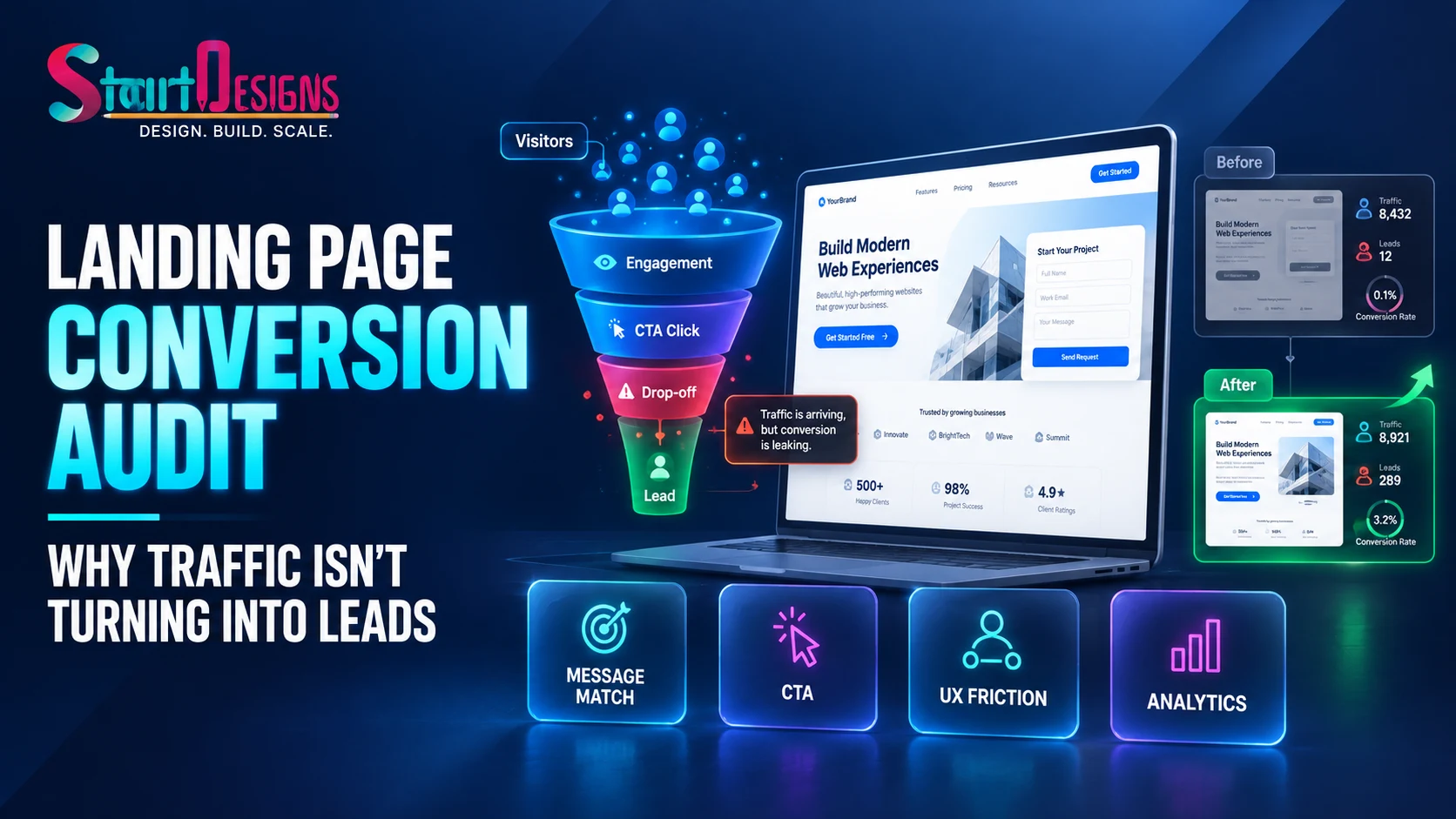
Landing Page Conversion Audit: Find Why Visitors Aren’t Taking Action
September 17, 2026- 8 Min Read


UI/UX Design Brief Template for Websites, Apps, and Ecommerce
August 6, 2026- 16 Min Read