
- About us
-
Services
- Back
- Development Services
-

-
-
-
- Designing Services
-
-
-
-
- Marketing Services
-
-
-
-
- Cloud Engineering Services
-
-
-
- ERP
-
-
-
- CRM
-
-
-
- Artificial Intelligence
-

-
-
-
- MVP
-
- Open Source Business
-
- Industry
- Portfolio
- Career
- Contact us
-
 info[at]startdesigns.com


Websites have traditionally been designed around human visitors. People browse pages, search for information, fill out forms, compare products, and complete purchases. But the way users interact with websites is beginning to change.
AI agents are introducing a new way to interact with digital experiences. Instead of simply answering questions or recommending information, these systems can understand a user’s goal, navigate digital workflows, interact with website features, and perform specific tasks with appropriate authorization.
This shift is creating new opportunities for businesses and developers. Websites may increasingly need to support two types of visitors: people who browse and interact directly, and AI agents that help people complete tasks.
For businesses, this means website development is no longer just about attractive layouts and responsive pages. It is also about creating intelligent, structured, secure, and accessible digital experiences.
In this guide, we will explore what agentic AI means for web development, how AI agents are changing website experiences, and what developers should consider when building websites for this evolving digital environment.
What Is Agentic AI in Web Development?
Agentic AI refers to AI systems that can work toward a defined goal by understanding instructions, planning actions, using available tools, and responding to the results.
Unlike a traditional chatbot that mainly provides answers, an AI agent can be designed to perform a sequence of actions.
For example, imagine a customer visiting a travel website and asking:
“I want to book a three-day trip to New York next month within my budget.”
A conventional chatbot might suggest destinations, hotels, or travel tips. An AI agent connected to the appropriate systems could potentially:
- Understand the customer’s travel preferences.
- Search available hotels and travel options.
- Compare options based on the user’s requirements.
- Check availability through connected services.
- Prepare a suggested itinerary.
- Present the options for customer approval before making a booking.
The agent does not simply display information. It works through a process to help achieve the requested outcome.
In web development, this creates opportunities to build websites and web applications that support more interactive, task-oriented experiences.
How AI Agents Are Changing Website Experiences
AI agents are changing the relationship between users and websites. Rather than requiring visitors to navigate every page manually, businesses can introduce intelligent features that help users reach their goals more efficiently.
Here are some important ways this change is taking place.
1. From Traditional Search to Intelligent Website Search
Traditional website search usually depends on matching keywords with available pages or products.
AI-powered search can understand the meaning and context behind a user’s query.
For example, someone visiting an online electronics store might search:
“Find me a laptop for video editing under $1,000 with good battery life.”
Instead of returning results based only on matching words, an AI-powered system can interpret the requirements, identify relevant products, and help compare their features.
For businesses, this can make product discovery more relevant and reduce the effort customers need to find suitable options.
2. Automated Customer Support and Task Completion
AI agents can help businesses manage customer interactions beyond basic question answering.
For example, an AI agent on a service website could:
- Answer common questions about services.
- Collect information about customer requirements.
- Check appointment availability.
- Help visitors schedule consultations.
- Send requests to the appropriate team.
- Provide updates using connected business systems.
These capabilities depend on the agent’s integrations, permissions, and the quality of the underlying data.
A well-designed system can reduce repetitive work while allowing human employees to focus on complex customer requirements.
3. Personalized Website Experiences
Most traditional websites display largely the same content to every visitor.
AI-powered experiences can make content and recommendations more relevant by considering a user’s preferences, previous interactions, and current requirements.
For example, an ecommerce website could recommend products based on a customer’s selected interests. A B2B website could guide visitors toward relevant services based on their industry and business needs.
Personalization should always respect user privacy and applicable data protection requirements. Businesses should also make it clear when AI is being used to process customer information.
4. Smarter Ecommerce and Online Transactions
Ecommerce websites involve several steps, including product discovery, comparison, cart management, checkout, and order tracking.
AI agents can help coordinate parts of this journey.
A shopping assistant, for example, could understand a customer’s requirements, compare products, answer questions about specifications, and help prepare a shopping cart.
With suitable integrations and explicit authorization, an agent may also assist with checkout-related actions.
However, sensitive actions such as payments, order placement, refunds, and changes to customer accounts should have appropriate permission checks and confirmation steps.
5. Better Appointment Booking and Lead Management
Service-based businesses often receive enquiries through contact forms, phone calls, and website chat interfaces.
AI agents can help connect these interactions with business workflows.
For example, a visitor looking for a software development partner could explain their project requirements. An AI agent could collect relevant information, identify the appropriate service category, and help schedule a consultation.
The collected information can then be passed to a CRM or another connected business system.
This creates a more organized experience for visitors while helping businesses manage incoming leads.
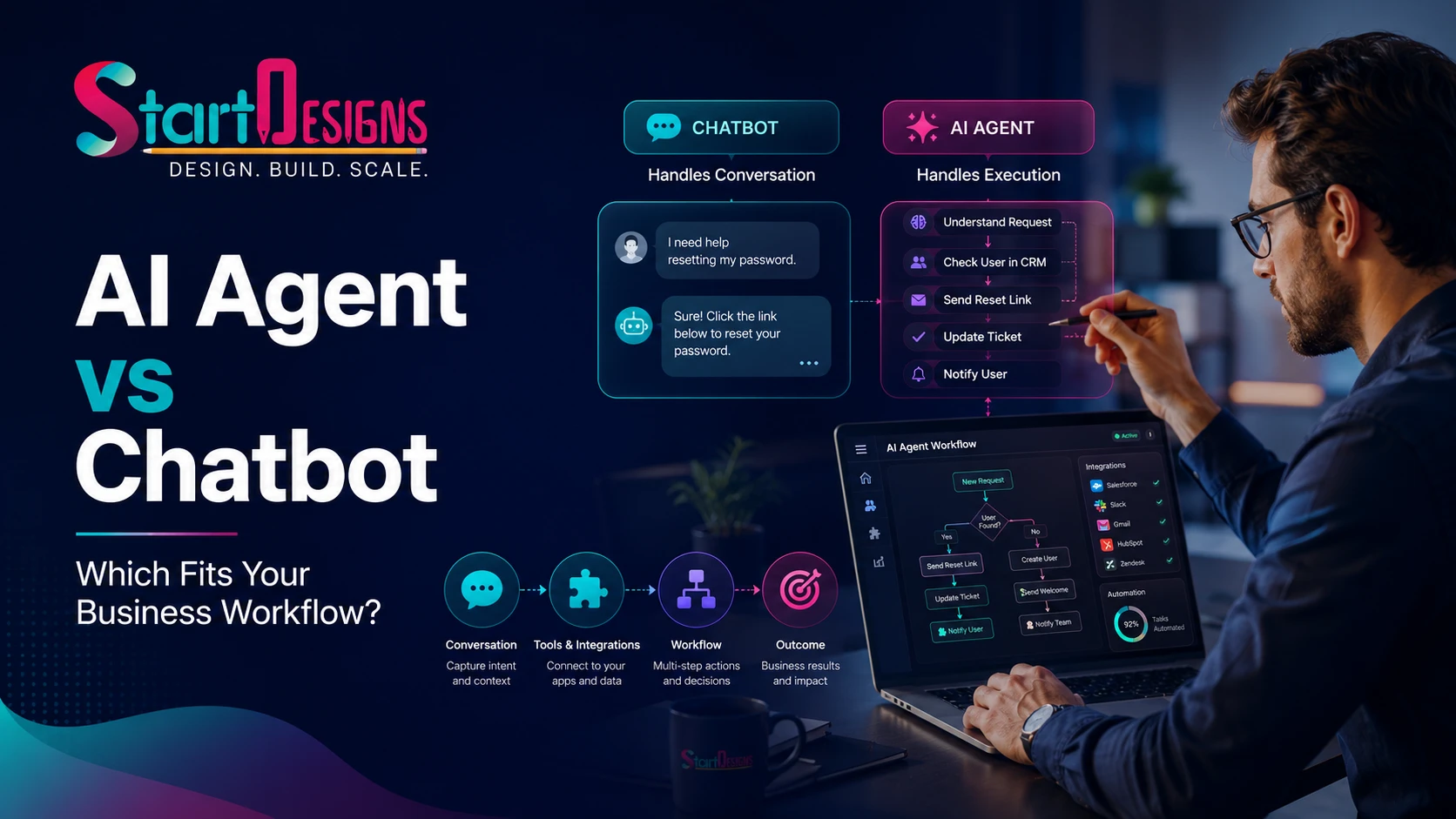
AI Agents vs Traditional Website Chatbots
AI agents and traditional chatbots can both support website visitors, but their capabilities are different.
| Feature | Traditional Chatbot | AI Agent |
|---|---|---|
| Main purpose | Answer questions | Work toward defined goals |
| Interaction | Conversation-focused | Conversation and task execution |
| Decision-making | Usually limited | Can plan actions within defined boundaries |
| Integrations | Often limited to FAQs or basic systems | Can use multiple connected tools |
| Workflow | Responds to individual messages | Can coordinate multiple steps |
| Human approval | Depends on the setup | Important for sensitive actions |
A chatbot can be the right solution when a business mainly needs to answer frequently asked questions.
An AI agent may be more suitable when the business needs to automate multi-step workflows, connect different systems, or help customers complete specific tasks.
If you want to understand the differences in more detail, read our existing guide: AI Agent vs Chatbot: A Business Workflow Decision Framework.
What Makes a Website Ready for AI Agents?
An AI agent cannot interact reliably with every website automatically. Websites need clear structures, predictable interfaces, and secure ways for authorized systems to access the actions they are allowed to perform.
Developers should consider the following areas when building agent-ready websites.
1. Clear HTML Structure and Semantic Elements
Semantic HTML helps browsers, assistive technologies, and automated systems understand the purpose of different elements.
For example, developers should use appropriate HTML elements such as:
<button>for interactive buttons.<form>for form submissions.<label>for form field descriptions.<nav>for navigation sections.<main>for primary page content.- Proper heading elements to organize information.
A visually attractive interface is not enough if its underlying structure is unclear.
Meaningful element names, accessible labels, and predictable page structures can make interactions more reliable.
2. Machine-Readable Website Actions
AI agents need to understand what actions are available and what information is required to perform them.
For example, a booking form should clearly identify the required information, such as:
- Customer name.
- Preferred date.
- Available time slot.
- Contact details.
- Booking confirmation.
Developers can expose website functionality through well-defined forms, APIs, and structured tools.
Google’s proposed WebMCP standard explores ways for websites to expose structured tools to browser-based AI agents. Instead of relying entirely on visual clicking, agents can use clearly defined website actions.
WebMCP is an emerging technology, so developers should evaluate its browser support and implementation status before using it in production.
3. Secure APIs and System Integrations
AI agents often need access to external systems to complete tasks.
For example, a booking agent may need to communicate with a scheduling platform, while an ecommerce agent may need to access product information or inventory data.
Developers should create secure API integrations with:
- Authentication and authorization.
- Role-based permissions.
- Input validation.
- Rate limiting.
- Secure handling of customer information.
- Logging and monitoring.
An AI agent should only access the information and functions required for its assigned task.
It should never receive unrestricted access to sensitive business systems simply because an integration is available.
4. Accessible and Predictable User Interfaces
Accessibility is important for human users, but it can also help AI agents understand website interfaces.
For example, interactive elements should have meaningful labels, forms should identify their fields clearly, and navigation should follow a consistent structure.
Developers should avoid relying only on visual icons or color to communicate the purpose of an action.
A properly structured accessibility tree can help automated systems identify interactive elements and understand their roles.
5. Website Performance and Stability
A website that loads slowly or changes its layout unexpectedly can create problems for both users and automated interactions.
Developers should focus on:
- Optimized images and media.
- Efficient JavaScript execution.
- Stable page layouts.
- Responsive design.
- Reliable form submissions.
- Consistent navigation.
- Proper error handling.
Performance and layout stability become especially important when an agent needs to interact with multiple elements in sequence.
What Is WebMCP and Why Should Developers Know About It?
WebMCP, or Web Model Context Protocol, is an emerging proposed web standard designed to make website functionality easier for AI agents to discover and use.
Traditionally, an AI agent interacting with a website may need to inspect the page, identify buttons and forms, and determine how to perform an action.
This approach can be unreliable when page layouts change or website controls are difficult to interpret.
WebMCP aims to provide a more structured way for websites to expose tools and actions to compatible AI agents.
For example, a travel website could expose structured actions for:
- Searching available destinations.
- Checking hotel availability.
- Comparing booking options.
- Retrieving reservation details.
The agent could then interact with these defined capabilities rather than trying to understand every visual element independently.
Google introduced WebMCP as a proposed standard in its 2026 developer updates. Its implementation and availability are still evolving, so it should be treated as an emerging development rather than a universal requirement.
Developers can explore Google’s WebMCP and agent-ready website guidance to understand the direction of these changes.
How to Test Whether a Website Is Ready for AI Agents
Building an agent-ready website requires testing beyond traditional visual and functional checks.
Developers should test whether an AI agent can understand the website, identify available actions, and complete important workflows safely.
Here are some practical checks.
1. Test Important User Journeys
Identify the most important actions visitors need to complete.
Examples include:
- Finding a product.
- Submitting a contact form.
- Booking an appointment.
- Creating an account.
- Checking an order status.
Test whether an AI agent can understand and complete these workflows using the available tools and permissions.
2. Check Accessibility and Semantic Structure
Review whether interactive elements have meaningful accessible names and whether forms contain clear labels.
Google’s Lighthouse Agentic Browsing audits can help developers identify issues related to accessibility, layout stability, and WebMCP integration.
3. Test API Reliability
Check whether connected APIs return predictable responses and handle errors correctly.
Developers should also test invalid inputs, expired authentication, unavailable services, and permission restrictions.
4. Review Security and User Permissions
An AI agent should not be able to perform sensitive actions without the required authorization.
Test whether the system correctly handles user consent, access permissions, data validation, and confirmation steps.
5. Monitor Agent Interactions
After deployment, monitor how agents interact with important website features.
Microsoft Clarity published research in October 2026 analyzing more than 5.2 million sessions involving AI agents. The study recorded activities such as checkout interactions, form submissions, and appointment bookings.
This highlights why businesses should pay attention not only to website visits but also to the actions that take place during agent-related sessions.
Read the Microsoft Clarity research on AI agent website activity.
Common Challenges of Agentic AI in Web Development
Although agentic AI creates new opportunities, implementing it successfully requires careful planning.
Data Privacy and Security
AI agents may interact with customer information, account details, and business systems. Developers must implement appropriate authentication, permissions, and data protection measures.
Unreliable Actions
AI systems can misunderstand instructions or produce unexpected results. Important operations should include validation, clear constraints, and human confirmation where necessary.
Integration Complexity
Connecting an AI agent with multiple systems can require custom APIs, authentication methods, and data synchronization.
Development and Maintenance Costs
AI-powered features may introduce additional costs related to development, infrastructure, model usage, monitoring, and ongoing maintenance.
Businesses should identify a clear use case before investing in complex agentic functionality.
User Trust and Transparency
Customers should understand when they are interacting with an AI system and when an action requires their approval.
Clear communication and easy access to human assistance can improve confidence in AI-powered experiences.
The Future of Agentic AI in Web Development
The web is gradually moving toward experiences where AI agents can do more than retrieve information.
They may help users compare products, schedule appointments, complete forms, manage bookings, and interact with different business platforms.
For developers, this means building websites with clearer structures, accessible interfaces, secure integrations, and reliable workflows.
Google’s work on WebMCP and agent-ready website testing shows that browser and web development tools are beginning to address these requirements.
However, businesses do not need to redesign every website around AI agents immediately. A practical approach is to identify repetitive user journeys, improve the underlying website structure, and introduce AI capabilities where they provide genuine value.
The goal should not be to add AI to every page. It should be to make important digital tasks easier, safer, and more efficient.
Conclusion
Agentic AI is creating a new direction for web development. Websites are beginning to evolve from static destinations into interactive digital environments where AI agents can help users complete meaningful tasks.
Businesses that prepare for this shift can explore new ways to improve customer experiences, automate repetitive workflows, and connect their digital platforms.
Achieving this requires more than adding an AI chatbot. It involves thoughtful website architecture, structured interactions, secure APIs, accessibility, and reliable development practices.
At Start Designs, we help businesses build modern digital solutions through custom development, AI integration, and scalable website experiences. Whether you are planning a new website or exploring AI-powered functionality for an existing platform, the right development strategy can help you prepare for the next generation of web experiences.
Explore our AI Agent Development Services and AI Website Development Services to learn how AI-powered solutions can support your business goals.
Frequently Asked Questions (FAQs)
1. What is agentic AI in web development?
Agentic AI in web development refers to AI systems that can understand goals, plan actions, and interact with website features or connected services to complete specific tasks.
2. How are AI agents different from website chatbots?
Traditional chatbots mainly respond to questions, while AI agents can use connected tools and systems to perform multi-step tasks within defined permissions.
3. Can AI agents interact with existing websites?
Yes. AI agents can interact with existing websites through browser-based interfaces, APIs, forms, and other supported integrations. The reliability of these interactions depends on the website’s structure and available capabilities.
4. What is WebMCP?
WebMCP is a proposed web standard designed to help websites expose structured tools and actions that compatible AI agents can discover and use.
5. Do businesses need to rebuild their websites for AI agents?
No. Businesses can start by improving their existing website structure, accessibility, APIs, and important user workflows. Larger changes can be introduced when there is a clear business requirement.
6. Is agentic AI suitable for small businesses?
Yes. Small businesses can explore AI agents for specific tasks such as answering customer questions, collecting enquiries, scheduling appointments, and automating repetitive workflows.
7. How can developers test whether a website is agent-ready?
Developers can test important user journeys, review accessibility and semantic HTML, validate API integrations, check permissions, and use tools such as Chrome DevTools and Lighthouse Agentic Browsing audits.
About the author

Popular Posts

PHP2Shell: Is Your Website Safe? A Plain-English Guide to Fixing the 2026 PHP Vulnerability
October 23, 2026- 13 Min Read
AI Transformation Strategy: How Businesses Build Intelligent AI-Powered Systems
August 26, 2026- 8 Min Read