

- About us
-
Services
- Back
- Development Services
-

-
-
-
- Designing Services
-
-
-
-
- Marketing Services
-
-
-
-
- Cloud Engineering Services
-
-
-
- ERP
-
-
-
- CRM
-
-
-
- Artificial Intelligence
-

-
-
-
- MVP
-
- Industry
- Portfolio
- Career
- Contact us
-
 info[at]startdesigns.com















Key Takeaways
- AI tools have become essential for ecommerce growth, not optional.
- Customer-facing AI delivers faster ROI compared to backend automation.
- The best tools do more than generate content; they take action across systems.
- Choosing the right AI tool depends on your business goal, not feature count.
- Integration with your ecommerce platform matters more than advanced AI claims.
Introduction
Ecommerce is changing fast. Customers expect instant replies, personalized recommendations, and seamless experiences across every touchpoint.
At the same time, businesses are under pressure to increase revenue while controlling costs.
This is why AI tools are now at the center of modern ecommerce operations.
But here is the problem. There are hundreds of AI tools in the market, and most of them sound similar.
So how do you choose what actually works?
In this guide, you will discover the best AI tools for ecommerce based on real use cases, practical value, and measurable results. You will also learn how to choose the right tools based on your business goals.
What Are the Best AI Tools for Ecommerce
The best AI tools for ecommerce depend on what you want to achieve.
- For customer support, automation tools like Fin and Gorgias are widely used.
- For email marketing and retention, Klaviyo and Omnisend perform strongly.
- For product discovery and personalization, Constructor and Bloomreach stand out.
- For content creation, Jasper and Photoroom are popular choices.
The right tool is the one that improves your conversion rate, reduces cost, or saves time.
Your Sales Today!
Why AI is Critical for Ecommerce in 2026
Ecommerce businesses are facing two major challenges.
- Customer expectations are increasing
- Operational costs are rising
- AI solves both problems simultaneously.
- For example, AI chat systems can reduce support workload by up to 30-40 percent by instantly resolving common queries.
- Personalization engines can improve conversion rates by showing more relevant products to users.
- Email automation tools can increase repeat purchases by targeting customers at the right time with the right message.
This is why AI is no longer a competitive advantage. It is becoming a basic requirement.
Types of AI Tools for Ecommerce
AI tools are used across the entire ecommerce journey.
- Customer support tools handle queries like order tracking, refunds, and returns
- Marketing automation tools manage email, SMS, and customer retention
- Product discovery tools improve search results and recommendations
- Content tools help create product descriptions and images
- Analytics tools provide insights into customer behavior and performance
Understanding these categories helps you invest in the right tools instead of chasing trends.
Best AI Tools for Ecommerce
Customer Support and Automation Tools
Fin
Fin is an AI agent that can resolve customer queries from start to finish using real-time data and system integrations.
Best for
Medium to large ecommerce businesses that want to automate support
Key features
- End-to-end query resolution
- Integration with order and customer data
- Continuous learning from interactions
Real use case
An ecommerce store can automate order tracking, refunds, and account updates without human intervention.
Pros
- Reduces cost per resolution
- Improves response speed and consistency
Limitations
Requires proper integration setup
Gorgias

Gorgias is a support platform built specifically for ecommerce brands.
Best for
Shopify and fast-growing ecommerce teams
Key features
- Centralized support dashboard
- AI-assisted responses
- Deep ecommerce integrations
Real use case
Manage all customer conversations from email, chat, and social media in one place.
Pros
- Easy to integrate
- Improves team productivity
Limitations
More support-focused than full automation
Tidio
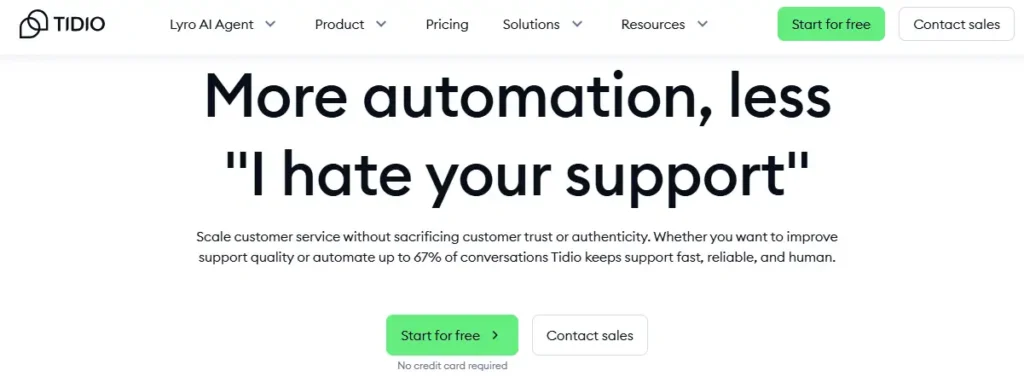
Tidio provides chat automation for small ecommerce stores.
Best for
Beginners and small businesses
Key features
- Live chat and automation
- Quick setup
- Pre-built templates
Real use case
Answer common customer questions instantly and reduce response time.
Pros
- Affordable and simple
- Fast implementation
Limitations
Limited advanced automation
Email and Lifecycle Marketing Tools
Klaviyo
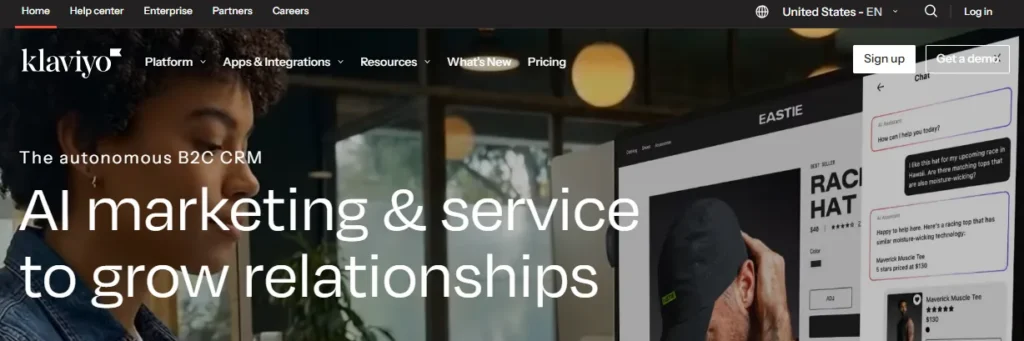
Klaviyo is a powerful email and SMS platform designed for ecommerce.
Best for
Retention and repeat purchases
Key features
- Advanced segmentation
- Automated flows
- Predictive analytics
Real use case
Recover abandoned carts and increase repeat purchases through targeted campaigns.
Pros
- Strong data-driven insights
- Highly customizable
Limitations
Requires learning and setup time
Omnisend

Omnisend helps manage email, SMS, and push notifications together.
Best for
Small to mid-sized ecommerce brands
Key features
- Omnichannel campaigns
- Automation workflows
- Easy setup
Real use case
Run coordinated campaigns across multiple channels to increase engagement.
Pros
- Simple to use
- Good multi-channel support
Limitations
Less advanced customization
GetResponse
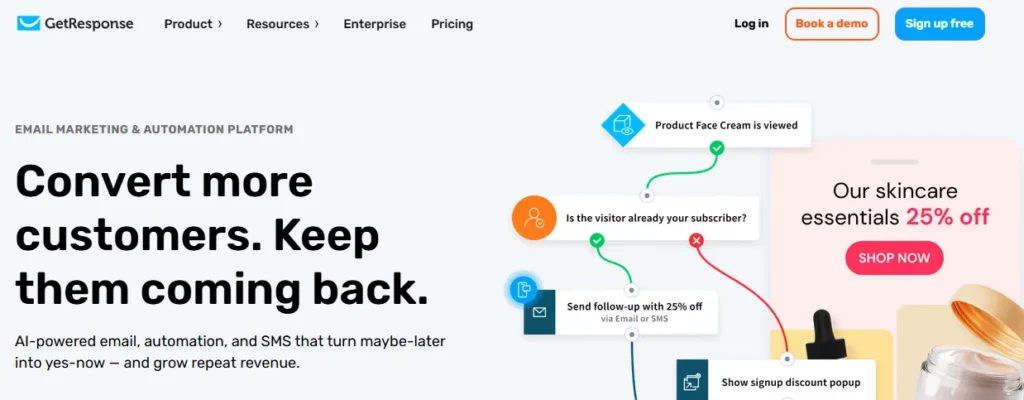
GetResponse combines email marketing with automation and AI assistance.
Best for
Startups and growing businesses
Key features
- Email automation
- Landing pages
- AI content suggestions
Real use case
Launch campaigns quickly without needing a large team.
Pros
- Beginner friendly
- Affordable
Limitations
Limited advanced features
Product Discovery and Personalization Tools
Constructor
Constructor improves ecommerce search and product recommendations using behavioral data.
Best for
Large ecommerce stores
Key features
- Search optimization
- Personalized recommendations
- Real-time data processing
Real use case
Show relevant products based on browsing behavior to increase conversion.
Pros
- Improves user experience
- Boosts revenue
Limitations
Setup can be complex
Bloomreach
Bloomreach focuses on personalization and customer experience.
Best for
Enterprise ecommerce brands
Key features
- AI-driven personalization
- Content optimization
- Customer insights
Real use case
Deliver personalized shopping journeys based on user preferences.
Pros
- Highly scalable
- Strong analytics
Limitations
Higher cost
Tolstoy
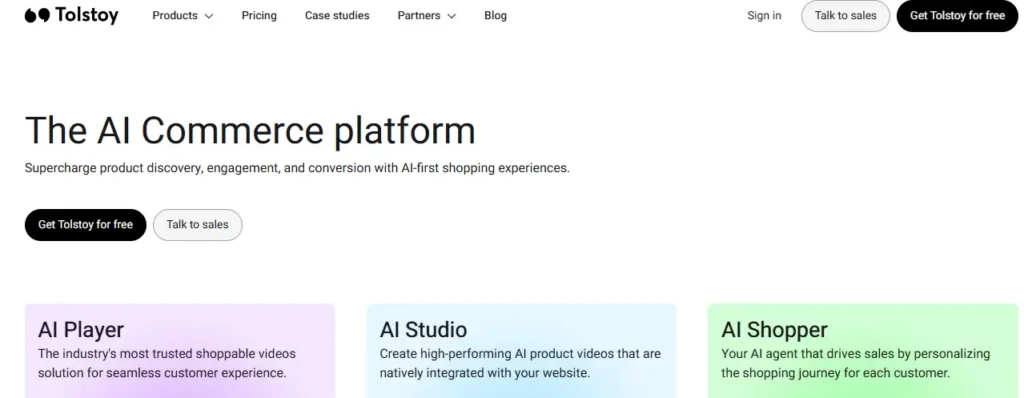
Tolstoy uses video to improve product discovery and engagement.
Best for
Visual ecommerce brands
Key features
- Interactive video content
- Personalized experiences
- Engagement tracking
Real use case
Guide customers through products using short videos.
Pros
- High engagement
- Unique experience
Limitations
Not suitable for all niches
Content and Creative Tools
Jasper
Jasper helps generate marketing and product content.
Best for
Content creation at scale
Key features
- AI writing
- Templates
- Brand tone control
Real use case
Create product descriptions for large catalogs quickly.
Pros
- Saves time
- Improves consistency
Limitations
Needs human editing
Flair AI
Flair AI creates product visuals and marketing images.
Best for
DTC brands
Key features
- AI-generated images
- Scene creation
- Visual editing
Real use case
Create marketing visuals without photoshoots.
Pros
- Cost effective
- Creative flexibility
Limitations
May need manual adjustments
Photoroom
Photoroom focuses on image editing and product photography improvements.
Best for
Marketplace sellers
Key features
- Background removal
- Image enhancement
- Batch editing
Real use case
Prepare clean product images for listings.
Pros
- Easy to use
- Fast results
Limitations
Limited design features
Analytics and Optimization Tools
FullStory
FullStory analyzes user behavior and experience.
Best for
Conversion optimization
Key features
- Session replay
- Behavior insights
- Performance tracking
Real use case
Identify friction points in the customer journey.
Pros
- Deep insights
- Improves UX
Limitations
Requires data analysis
Triple Whale
Triple Whale helps ecommerce brands understand marketing performance.
Best for
DTC brands
Key features
- Attribution tracking
- Performance dashboards
- Data insights
Real use case
Track which campaigns generate revenue.
Pros
- Clear reporting
- Useful for scaling
Limitations
Setup required
Polar Analytics
Polar Analytics centralizes ecommerce data into one dashboard.
Best for
Data-driven teams
Key features
- Data integration
- Reporting dashboards
- AI insights
Real use case
Track business performance across platforms.
Pros
- Saves time
- Better decision-making
Limitations
Initial setup needed
Comparison Table
| Tool | Best For | Ease of Use | Integration | Impact Level |
|---|---|---|---|---|
| Fin | Support automation | Medium | High | Very High |
| Klaviyo | Email marketing | Medium | High | Very High |
| Constructor | Personalization | Medium | High | High |
| Jasper | Content creation | Easy | Medium | High |
How to Choose the Right AI Tool for Ecommerce
Choosing the right AI tool starts with understanding your goal.
- If your goal is to reduce support costs, focus on automation tools
- If your goal is to increase sales, focus on personalization and marketing tools
- If your goal is efficiency, focus on content and analytics tools
- Next, evaluate integration. The tool must connect with your ecommerce platform, customer data, and order system.
- Then measure impact using real metrics such as conversion rate, cost per order, and customer satisfaction.
Start with one tool, test results, and expand gradually.
What Separates High-Impact AI Tools from Low-Impact Tools
High-impact tools are different in a few key ways.
- They do not just generate responses; they take action
- They use real-time data instead of static inputs
- They integrate deeply with your systems
- They improve measurable business outcomes
Low-impact tools often look impressive but do not deliver real results.
Real Results Ecommerce Brands Are Seeing
AI adoption is already delivering measurable results.
- Support automation can reduce workload by up to 40 percent
- Email automation improves repeat purchases and customer retention
- Personalization increases conversion rates and average order value
- Analytics tools help identify growth opportunities faster
These results show that AI is driving real business impact.
Future of AI in Ecommerce
Ecommerce is moving towards fewer but more powerful AI systems.
- Instead of using multiple tools, businesses are starting to rely on platforms that can handle support, marketing, and analytics together.
- AI systems are also becoming more capable of handling complete workflows, not just individual tasks.
- This shift will make ecommerce operations more efficient and scalable.
FAQs
What are AI tools for ecommerce
AI tools automate tasks like customer support, marketing, personalization, and analytics.
Which AI tool is best for beginners
Tools like Tidio and Omnisend are easy to start with.
Can AI increase ecommerce sales
Yes, AI improves conversion through personalization and automation.
Are AI tools difficult to use
Many tools are designed for ease of use, but advanced tools may require setup.
Conclusion
AI is no longer optional for ecommerce businesses.
The real advantage comes from choosing the right tools and using them strategically.
Start with one tool that solves your biggest problem, measure the results, and scale from there.
That is how modern ecommerce brands are growing faster in 2026.
About the author

Popular Posts

Big Brands Using Magento in 2026 with Real Examples, Use Cases and Insights
March 31, 2026- 5 Min Read

What is Lovable AI? Discover the Magic Behind the Lovable Builder
January 28, 2026- 7 Min Read